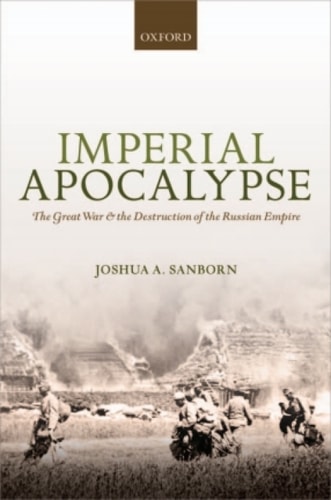
Imperial Apocalypse: The Great War and the Destruction of the Russian Empire
0
0
As an Amazon Associate and affiliate partner, Menrva Books earns from qualifying purchases. Learn more
Author Description
Imperial Apocalypse describes the collapse of the Russian Empire during World War One. Drawing material from nine different archives and hundreds of published sources, this study ties together state failure, military violence, and decolonization in a single story. Joshua Sanborn excavates the individual lives of soldiers, doctors, nurses, politicians, and civilians caught up in the global conflict along the way, creating a narrative that is both humane and conceptually rich. The volume opens by laying out the theoretical relationship between state failure, social collapse, and decolonization, and then moves chronologically from the Balkan Wars of 1912-13 through the fierce battles and massive human dislocations of 1914-16 to the final collapse of the empire in the midst of revolution in 1917-18. Imperial Apocalypse is the first major study which treats the demise of the Russian Empire as part of the twentieth-century phenomenon of modern decolonization, and provides a readable account of military activity and political change throughout this turbulent period of war and revolution. Sanborn argues that the sudden rise of groups seeking national self-determination in the borderlands of the empire was the consequence of state failure, not its cause. At the same time, he shows how the destruction of state institutions and the spread of violence from the front to the rear led to a collapse of traditional social bonds and the emergence of a new, more dangerous, and more militant political atmosphere.
Menrva's Summary
THE THESIS
This study investigates how the collapse of the Russian Empire during World War I functioned as a primary example of state failure and modern decolonization. Joshua A. Sanborn, a scholar of Russian history, utilizes extensive archival research and primary source material to construct a framework that links military violence with the disintegration of imperial social structures. He argues that the rise of national self-determination movements in the borderlands was a direct consequence of the state's inability to maintain order rather than the initial catalyst for its collapse.
THE SCOPE MAP
What You Will Find
- A chronological analysis spanning from the Balkan Wars of 1912-13 through the Russian Revolution of 1917-18.
- An examination of the intersection between military front-line activity and civilian social dislocation.
- Primary source evidence derived from nine distinct archives and hundreds of published accounts.
Scope Limits
- The study focuses primarily on the Russian Empire and does not provide a comprehensive comparative analysis of other collapsing empires of the same era.
- It does not offer a detailed military tactical history of every engagement, focusing instead on the broader institutional and social consequences of the conflict.
THE AUTHORITY PERSPECTIVE
Historians and scholars of the period recognize this work as a significant contribution to the understanding of the Russian Empire's demise through the lens of decolonization. Readers frequently note the academic density of the prose and the author's success in synthesizing complex social and political shifts into a coherent historical narrative.
Page Count:
304
Publication Date:
2014-01-01
Publisher:
OUP Oxford
ISBN-10:
019101544X
ISBN-13:
9780191015441
History
Decolonization
World War
Russian History
history russia
Military History
Modern History
Community Tags
Other Editions(2)

Similar Books