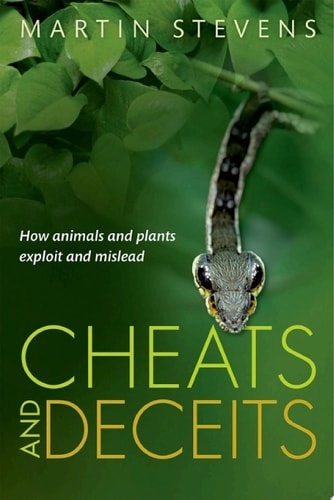
Cheats and Deceits: How Animals and Plants Exploit and Mislead
0
0
As an Amazon Associate and affiliate partner, Menrva Books earns from qualifying purchases. Learn more
Author Description
In nature, trickery and deception are widespread. Animals and plants mimic other objects or species in the environment for protection, trick other species into rearing their young, lure prey to their death, and deceive potential mates for reproduction. Cuckoos lay eggs carefully matched to their host's own clutch. Harmless butterflies mimic the wing patterning of a poisonous butterfly to avoid being eaten. The deep-sea angler fish hangs a glowing, fleshy lure in front of its mouth to draw the attention of potential prey, while some male fish alter their appearance to look like females in order to sneak past rivals in mating. Some orchids develop the smell of female insects in order to attract pollinators, while carnivorous plants lure insects to their death with colourful displays. In this book, Martin Stevens describes the remarkable range of such adaptations in nature, and considers how they have evolved, and become increasingly perfected as part of an arms race between predator and prey or host and parasite. He explores the work of naturalists and biologists from Alfred Russel Wallace to current research, showing how scientists find ways of testing the impact of particular behaviours and colourings on the animals it is meant to fool, as opposed to our human perceptions. Drawing on a wide range of examples, Stevens considers what deception tells us about the process of evolution and adaptation.
Menrva's Summary
THE THESIS
This book investigates the evolutionary mechanisms and biological functions behind the widespread prevalence of deception and mimicry in the natural world. Martin Stevens, a professor of sensory and evolutionary ecology, synthesizes decades of biological research to explain how these adaptations function as survival strategies. He examines the ongoing arms race between predators and prey, as well as hosts and parasites, to illustrate how natural selection refines deceptive traits over time.
THE SCOPE MAP
What You Will Find
- Analysis of mimicry, luring, and reproductive deception in both flora and fauna
- Historical context of evolutionary research from Alfred Russel Wallace to modern field studies
- Methodologies for testing animal perception versus human observation
- Case studies ranging from deep-sea angler fish to parasitic cuckoos
Scope Limits
- The text does not provide an exhaustive catalog of every known deceptive species
- It does not focus on the philosophical implications of deception outside of biological evolution
THE AUTHORITY PERSPECTIVE
Experts recognize this work as a comprehensive overview of sensory ecology and evolutionary adaptation. Readers frequently note the accessibility of the prose despite the technical depth of the biological concepts presented.
Page Count:
320
Publication Date:
2016-01-01
Publisher:
OUP Oxford
ISBN-10:
0191017612
ISBN-13:
9780191017612
Nature
Science
Evolutionary Biology
Plants
Zoology
Deception
Biology
Botany
Community Tags
Similar Books