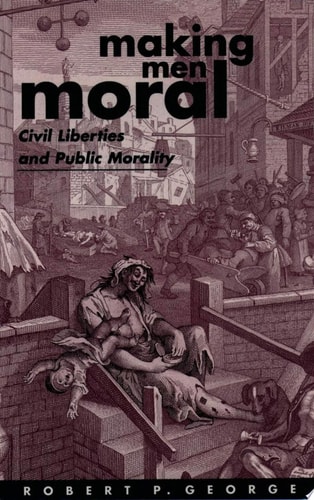
Making Men Moral
0
0
As an Amazon Associate and affiliate partner, Menrva Books earns from qualifying purchases. Learn more
Author Description
Contemporary Liberal Thinkers Commonly Suppose That There Is Something In Principle Unjust About The Legal Prohibition Of Putatively Victimless Immoralities. Against The Prevailing Liberal View, Robert P. George Defends The Proposition That `moral Laws' Can Play A Legitimate, If Subsidiary, Role In Preserving The `moral Ecology' Of The Cultural Environment In Which People Make The Morally Significant Choices By Which They Form Their Characters And Influence, For Good Or Ill, The Moral Lives Of Others. George Shows That A Defence Of Morals Legislation Is Fully Compatible With A `pluralistic Perfectionist' Political Theory Of Civil Liberties And Public Morality.
Menrva's Summary
THE THESIS
This work investigates whether the legal prohibition of victimless immoralities is inherently unjust within a liberal democratic framework. Robert P. George, a prominent legal scholar and professor of jurisprudence, challenges the prevailing liberal consensus by arguing that moral legislation serves a necessary function in maintaining the cultural environment. He posits that the state has a legitimate, albeit limited, role in fostering the conditions under which individuals develop their moral character.
THE SCOPE MAP
What You Will Find
- A defense of moral legislation within a pluralistic perfectionist political theory.
- Analysis of the relationship between law, morality, and the cultural environment.
- Theoretical arguments regarding the state's role in preserving moral ecology.
Scope Limits
- The text does not provide a comprehensive legislative guide for specific moral crimes.
- The analysis focuses primarily on theoretical and philosophical justifications rather than empirical sociological data.
THE AUTHORITY PERSPECTIVE
Scholars and legal theorists frequently cite this work as a significant contribution to the debate on perfectionist political theory. Readers often note the high level of academic rigor and the dense, philosophical nature of the prose throughout the text.
Page Count:
258
Publication Date:
1995-01-01
Publisher:
Clarendon Press
ISBN-10:
0191029602
ISBN-13:
9780191029608
Law
Political Philosophy
Ethics
Conservative Philosophy
Legal Theory
Community Tags
Similar Books