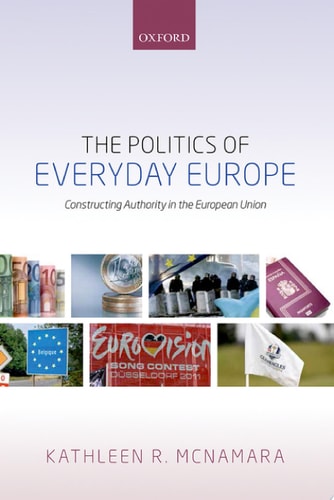
The Politics of Everyday Europe: Constructing Authority in the European Union
0
0
As an Amazon Associate and affiliate partner, Menrva Books earns from qualifying purchases. Learn more
Author Description
How do political authorities build support for themselves and their rule? Doing so is key to accruing power, but it can be a complicated affair. The European Union, as a novel political entity, faces a particularly difficult set of challenges. The Politics of Everyday Europe argues that the legitimation of EU authority rests in part on a transformation in the symbols and practices of everyday life in Europe. The Single Market and the Euro, the legal category of European Citizen and policies promoting the free movement of people, EU public architecture, arts and popular entertainment, and EU diplomacy and foreign policy all generate symbols and practices that change peoples' day-to-day experiences naturalizing European governance.The modern nation-state has long used similar strategies of nationalism and 'imagined communities' to legitimize its political power. But the EU's cultural infrastructure is unique, as it navigates European national identities with a particularly banality, trying to make the EU seem complementary to, not in competition with, the nation-states. While this cultural legitimation has successfully underpinned the EU's surprising political development, Europe today is more often met with indifference by its citizens rather than affection. As economic and political crises have stretched European social solidarity to the breaking point, this book offers a clear theoretical framework for understanding how everyday culture matters fundamentally in the political life of the EU, and how the construction of meaning can be a potent power resource-albeit one open to contestation and subversion by the very citizens it calls into being.
Menrva's Summary
THE THESIS
This book investigates how the European Union constructs political authority and legitimacy through the transformation of symbols and practices in the everyday lives of its citizens. Kathleen R. McNamara, a professor of government and foreign service, utilizes a constructivist framework to analyze how the EU attempts to naturalize its governance. She argues that by embedding itself into mundane aspects of life—such as currency, architecture, and travel—the EU seeks to build a cultural infrastructure that complements, rather than replaces, national identities.
THE SCOPE MAP
What You Will Find
- Analysis of EU symbols including the Single Market, the Euro, and public architecture.
- Examination of the legal category of European citizenship and free movement policies.
- Theoretical application of 'imagined communities' to the unique context of supranational governance.
Scope Limits
- The text does not provide a comprehensive history of EU legislative processes or economic policy mechanics.
- It focuses primarily on cultural and symbolic legitimation rather than purely institutional or legalistic power structures.
THE AUTHORITY PERSPECTIVE
Scholars in the field of European studies frequently cite this work for its innovative focus on the cultural dimensions of supranational legitimacy. Readers note that the prose is accessible yet theoretically rigorous, making it a standard reference for understanding the intersection of identity politics and institutional authority in the EU.
Page Count:
224
Publication Date:
2015-01-01
Publisher:
OUP Oxford
ISBN-10:
0191025526
ISBN-13:
9780191025525
European
International relations
Politics And Culture
Sociology
European Union
Political Theory
Community Tags
Similar Books