Making New Words: Morphological Derivation in English
0
0
As an Amazon Associate and affiliate partner, Menrva Books earns from qualifying purchases. Learn more
Author Description
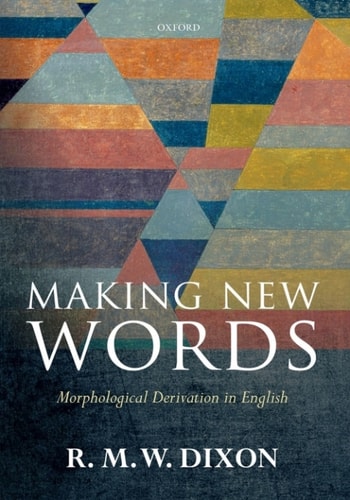
Making New Words provides a detailed study of the 200 or so prefixes and suffixes which create new words in today's English. Alongside a systematic discussion of these forms, Professor Dixon explores and explains the hundreds of conundrums that seem to be exceptions to general rules. Why, for instance, do we say un-distinguished (with prefix un-) but in-distinguishable (with in-); why un-ceasing but in-cesssant? Why, alongside gold-en, do we say silver-y (not silver-en)? Why is it wood-en (not wood-ic) but metall-ic (not metall-en)? After short preliminary chapters, which set the scene and outline the criteria employed, there are accounts of the derivation of negative words, of other derivations which do not change word class, on making new verbs, new adjectives, new nouns, and new adverbs. The final chapter deals with combinations of suffixes, of prefixes, and of the two together. Within each chapter, derivational affixes are arranged in semantic groups, the members of which are contrasted with respect to meaning and function; for example, child-less and child-free. For each affix there is an account of its genetic origin (from Old English, Greek, Latin, French, and so on), its phonological form and implications for stress placement, the roots it can be attached to (and why), and how its range of meanings has developed over the centuries. The book is written in the author's accustomed style - clear and well-organised, with easy-to-understand explanations. The exposition is illustrated by examples, ranging from Shakespeare, W. S. Gilbert, and modern novels to what was heard on the radio. It will be an invaluable text and sourcebook for scholars and students of the English language and of general linguistics, from undergraduate level upwards. The many fascinating facts presented here, in such a lucid and accessible manner, will also appeal to the general reader interested in picking to pieces the English language to see how it works.
Menrva's Summary
THE THESIS
This book investigates the mechanisms of morphological derivation in the English language, specifically focusing on the approximately 200 prefixes and suffixes used to generate new words. R. M. W. Dixon, a distinguished linguist, utilizes a systematic approach to categorize these affixes while addressing the irregularities and exceptions that frequently complicate English word formation. By analyzing the historical origins, phonological constraints, and semantic functions of these forms, the author provides a comprehensive framework for understanding how the language expands and adapts.
THE SCOPE MAP
What You Will Find
- A systematic classification of English prefixes and suffixes organized by semantic function.
- Detailed etymological histories for each affix, tracing roots from Old English, Greek, Latin, and French.
- Analysis of phonological implications, including stress placement and root compatibility.
- Illustrative examples drawn from diverse sources including literature, classical texts, and contemporary media.
Scope Limits
- The text focuses primarily on derivational morphology rather than inflectional morphology.
- It does not provide an exhaustive dictionary of every possible word formation but focuses on the rules and patterns governing the most common affixes.
THE AUTHORITY PERSPECTIVE
Linguists and students frequently cite this work as a clear and well-organized resource for understanding the complexities of English word formation. The text is widely regarded as an accessible yet rigorous sourcebook for both academic researchers and general readers interested in the mechanics of the language.
Page Count:
432
Publication Date:
2014-01-01
Publisher:
OUP Oxford
ISBN-10:
0191021156
ISBN-13:
9780191021152
English
Etymology
Reference
English & College Success
Linguistics
Morphology
Community Tags
Similar Books