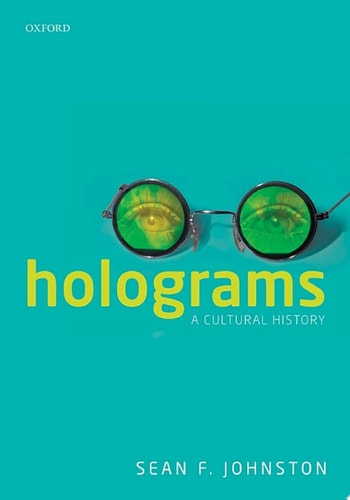
Holograms: A Cultural History
0
0
As an Amazon Associate and affiliate partner, Menrva Books earns from qualifying purchases. Learn more
Author Description
Holograms have been in the public eye for over a half-century, but their influences have deeper cultural roots. No other visual experience is quite like interacting with holograms; no other cultural product melds the technological sublime with magic and optimism in quite the same way. As holograms have evolved, they have left their audiences alternately fascinated, bemused, inspired or indifferent. From expressions of high science to countercultural art to consumer security, holograms have represented modernity, magic and materialism. Their most pervasive impact has been to galvanise hopeful technological dreams. Engineers, artists, hippies and hobbyists have played with, and dreamed about, holograms. This book explores how holograms found a place in distinct cultural settings. It is aimed at readers attracted to pop culture, visual studies and cultural history, scholars concerned with media history, fine art and material studies and, most of all, cross-disciplinary audiences intrigued about how this ubiquitous but still-mysterious visual medium grew up in our midst and became entangled in our culture. This book explores the technical attractions and cultural uses of the hologram, how they were shaped by what came before them, and how they have matured to shape our notional futures. Today, holograms are in our pockets (as identity documents) and in our minds (as gaming fantasies and 'faux hologram' performers). Why aren't they more often in front of our eyes?
Menrva's Summary
THE THESIS
This book investigates the complex intersection of technological development and cultural perception that has defined the hologram's trajectory over the last half-century. Sean F. Johnston, a historian of science and technology, utilizes a multidisciplinary approach to analyze how holography evolved from a scientific curiosity into a pervasive cultural symbol. He argues that the medium's history is not merely a record of technical advancement, but a reflection of shifting societal attitudes toward modernity, magic, and material progress.
THE SCOPE MAP
What You Will Find
- Historical analysis of holography from its inception to contemporary applications.
- Examination of the diverse groups involved in the medium, including engineers, artists, and hobbyists.
- Exploration of the hologram's role in security, fine art, and popular media.
Scope Limits
- The text does not provide a technical manual or instructional guide for creating holograms.
- It does not focus exclusively on the physics of light interference, prioritizing cultural impact over pure optics.
THE AUTHORITY PERSPECTIVE
Scholars and readers in the fields of media history and visual studies frequently cite this work for its ability to bridge the gap between technical history and cultural theory. Experts highlight the text as a comprehensive resource for understanding how a specific visual medium becomes embedded in the collective imagination.
Page Count:
271
Publication Date:
2015-01-01
Publisher:
OUP Oxford
ISBN-10:
0191021385
ISBN-13:
9780191021381
History
Technology
Media Studies
Science History
Visual Arts
Holography
Earth Sciences