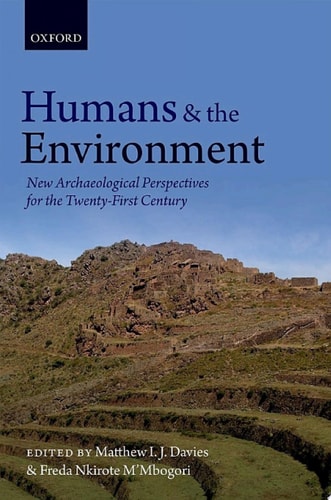
Humans and the Environment: New Archaeological Perspectives for the Twenty-First Century
0
0
As an Amazon Associate and affiliate partner, Menrva Books earns from qualifying purchases. Learn more
Author Description
The environment has always been a central concept for archaeologists and, although it has been conceived in many ways, its role in archaeological explanation has fluctuated from a mere backdrop to human action, to a primary factor in the understanding of society and social change. Archaeology also has a unique position as its base of interest places it temporally between geological and ethnographic timescales, spatially between global and local dimensions, and epistemologically between empirical studies of environmental change and more heuristic studies of cultural practice. Drawing on data from across the globe at a variety of temporal and spatial scales, this volume resituates the way in which archaeologists use and apply the concept of the environment. Each chapter critically explores the potential for archaeological data and practice to contribute to modern environmental issues, including problems of climate change and environmental degradation. Overall the volume covers four basic themes: archaeological approaches to the way in which both scientists and locals conceive of the relationship between humans and their environment, applied environmental archaeology, the archaeology of disaster, and new interdisciplinary directions.The volume will be of interest to students and established archaeologists, as well as practitioners from a range of applied disciplines.
Menrva's Summary
THE THESIS
This volume investigates how the concept of the environment can be re-evaluated within archaeological practice to better address contemporary global challenges. Editors Freda Nkirote M'Mbogori and Matthew I. J. Davies compile diverse research to argue that archaeology occupies a unique temporal and spatial position capable of bridging empirical environmental data with cultural practice. By analyzing global datasets, the contributors demonstrate how historical human-environment interactions provide critical context for understanding modern climate change and ecological degradation.
THE SCOPE MAP
What You Will Find
- Analysis of archaeological approaches to human-environment relationships
- Frameworks for applied environmental archaeology
- Studies concerning the archaeology of disaster
- Interdisciplinary methodologies for future research
Scope Limits
- Does not provide a comprehensive history of all environmental archaeology
- Focuses primarily on theoretical and applied shifts rather than site-specific excavation reports
THE AUTHORITY PERSPECTIVE
Experts identify this volume as a significant contribution to the evolving discourse on how archaeology informs modern environmental policy. Readers frequently note the academic density of the prose, making it a suitable resource for advanced students and professional practitioners in the field.
Page Count:
371
Publication Date:
2013-01-01
Publisher:
OUP Oxford
ISBN-10:
0191029939
ISBN-13:
9780191029936
Environmental archaeology
Climate Change
Cultural Anthropology
Social Science
Anthropology
Nature
Archaeology
Community Tags
Similar Books