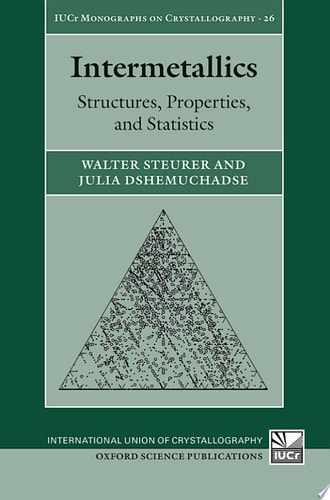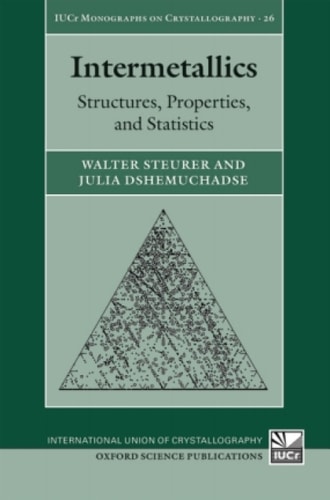
Intermetallics: Structures, Properties, and Statistics
0
0
As an Amazon Associate and affiliate partner, Menrva Books earns from qualifying purchases. Learn more
Author Description
The fascinating world of intermetallics is largely unexplored. There are many exciting physical properties and important technological applications of intermetallics, from magnetism to superconductivity. The main focus of this book is on the statistics, topology and geometry of crystal structures and structure types of intermetallic phases. The underlying physics, in particular chemical bonding, is discussed whenever it helps understand the stability of structures and the origin of their physical properties. The authors' approach, based on the statistical analysis of more than twenty thousand intermetallic compounds in the data base Pearson's Crystal Data, uncovers important structural relationships and illustrates the relative simplicity of most of the general structural building principles. It also shows that a large variety of actual structures can be related to a rather small number of aristotypes. The text aims to be readable and beneficial in one way or another to everyone interested in intermetallic phases, from graduate students to experts in solid state chemistry and physics, and materials science. For that purpose it avoids the use of enigmatic abstract terminology for the classification of structures. Instead, it focuses on the statistical analysis of crystal structures and structure types in order to draw together a larger overview of intermetallics, and indicate the gaps in it - areas still to be explored, and potential sources of worthwhile research. The text should be read as a reference guide to the incredibly rich world of intermetallic phases.
Menrva's Summary
THE THESIS
This book investigates the structural relationships, geometric principles, and statistical patterns governing the vast array of known intermetallic compounds. The authors, Julia Dshemuchadse and Walter Steurer, utilize a comprehensive dataset of over twenty thousand compounds from Pearson's Crystal Data to establish a framework for understanding how complex intermetallic structures derive from a limited set of fundamental building blocks or aristotypes. By prioritizing geometric and topological analysis over abstract classification, the text provides a systematic method for identifying structural trends and predicting potential areas for future research in solid state science.
THE SCOPE MAP
What You Will Find
- Statistical analysis of over twenty thousand intermetallic compounds
- Geometric and topological classification of crystal structure types
- Discussion of chemical bonding as it relates to structural stability
- Identification of structural gaps and research opportunities
Scope Limits
- Does not provide an exhaustive encyclopedia of every known intermetallic phase
- Avoids highly abstract or niche terminology in favor of broader structural principles
THE AUTHORITY PERSPECTIVE
Experts and researchers in materials science identify this work as a significant reference for understanding the structural landscape of intermetallic phases. Readers frequently note the clarity of the statistical approach, which makes complex crystallographic data accessible to both graduate students and established professionals in the field.
Page Count:
608
Publication Date:
2016-01-01
Publisher:
OUP Oxford
ISBN-10:
0191023922
ISBN-13:
9780191023927
Science
Chemistry
Earth Sciences
Solid state chemistry
Physics