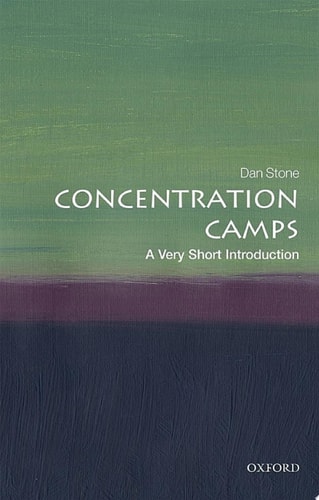
Concentration Camps: A Very Short Introduction
0
0
As an Amazon Associate and affiliate partner, Menrva Books earns from qualifying purchases. Learn more
Author Description
Concentration camps are a relatively new invention, a recurring feature of twentieth century warfare, and one that is important to the modern global consciousness and identity. Although the most famous concentration camps are those under the Nazis, the use of concentration camps originated several decades before the Third Reich, in the Philippines and in the Boer War, and they have been used again in numerous locations, not least during the genocides in Bosnia and Rwanda. Over the course of the twentieth century they have become defining symbols of humankind's lowest point and basest acts. In this Very Short Introduction, Dan Stone gives a global history of concentration camps, and shows that it is not only "mad dictators" who have set up camps, but instead all varieties of states, including liberal democracies, that have made use of them. Setting concentration camps against the longer history of incarceration, he explains how the ability of the modern state to control populations led to the creation of this extreme institution. Looking at their emergence and spread around the world, Stone argues that concentration camps serve the purpose, from the point of view of the state in crisis, of removing a section of the population that is perceived to be threatening, traitorous, or diseased. Drawing on contemporary accounts of camps, as well as the philosophical literature surrounding them, Stone considers the story camps tell us about the nature of the modern world as well as about specific regimes. ABOUT THE SERIES: The Very Short Introductions series from Oxford University Press contains hundreds of titles in almost every subject area. These pocket-sized books are the perfect way to get ahead in a new subject quickly. Our expert authors combine facts, analysis, perspective, new ideas, and enthusiasm to make interesting and challenging topics highly readable.
Menrva's Summary
THE THESIS
This book investigates the origins, global proliferation, and function of concentration camps as a recurring instrument of state power in the modern era. Dan Stone, a professor of modern history and director of the Holocaust Research Institute at Royal Holloway, University of London, utilizes a comparative historical framework to analyze these institutions. He argues that concentration camps are not merely the tools of totalitarian regimes, but are a structural feature of modern statecraft used by various political systems, including liberal democracies, to manage perceived threats to national security or social order.
THE SCOPE MAP
What You Will Find
- A global historical survey of concentration camps from the Boer War and the Philippines to Bosnia and Rwanda.
- An analysis of the relationship between state crisis and the necessity of population control.
- Integration of philosophical literature and primary source accounts of camp life.
Scope Limits
- The text provides a concise overview rather than an exhaustive, encyclopedic catalog of every historical camp.
- It focuses on the political and structural function of the camps rather than detailed biographical accounts of individual survivors.
THE AUTHORITY PERSPECTIVE
Experts and readers recognize this work as a highly accessible, scholarly synthesis of a complex and grim subject. The prose is noted for its academic rigor while remaining concise enough for students and general readers to grasp the broader implications of state-sanctioned incarceration.
Page Count:
160
Publication Date:
2019-01-01
Publisher:
OUP Oxford
ISBN-10:
0191035025
ISBN-13:
9780191035029
History
Sociology
Human rights
Community Tags
Other Editions(2)
Similar Books






Reader Comments
Share Your Thoughts
No comments yet. Be the first to share your thoughts!