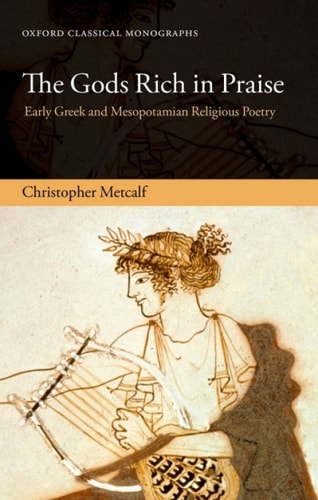
The Gods Rich in Praise: Early Greek and Mesopotamian Religious Poetry
0
0
As an Amazon Associate and affiliate partner, Menrva Books earns from qualifying purchases. Learn more
Author Description
Many scholars today believe that early Greek literature, as represented by the great poems of Homer and Hesiod, was to some extent inspired by texts from the neighbouring civilizations of the ancient Near East, especially Mesopotamia. It is true that, in the case of religious poetry, early Greek poets sang about their gods in ways that resemble those of Sumerian or Akkadian hymns from Mesopotamia, but does this mean that the latter influenced the former, and if so, how? This volume is the first to attempt an answer to these questions by undertaking a detailed study of the ancient texts in their original languages, from Sumerian poetry in the 20th century BC to Greek sources from the times of Homer, Hesiod, Pindar, and Aeschylus. The Gods Rich in Praise presents the core groups of sources from the ancient Near East, describing the main features of style and content of Sumerian and Akkadian religious poetry, and showing how certain compositions were translated and adapted beyond Mesopotamia. It proceeds by comparing selected elements of form and content: hymnic openings, negative predication, the birth of Aphrodite in the Theogony of Hesiod, and the origins and development of a phrase in Hittite prayers and the Iliad of Homer. The volume concludes that, in terms of form and style, early Greek religious poetry was probably not indebted to ancient Near Eastern models, but also argues that such influence may nevertheless be perceived in certain closely defined instances, particularly where supplementary evidence from other ancient sources is available, and where the extant sources permit a reconstruction of the process of translation and adaptation.
Menrva's Summary
THE THESIS
This volume investigates the extent to which early Greek religious poetry was influenced by the literary traditions of the ancient Near East, specifically Mesopotamia. Christopher Metcalf, a specialist in classical and Near Eastern philology, utilizes a comparative analysis of original Sumerian, Akkadian, and Greek texts to evaluate potential cross-cultural transmission. The author argues that while broad stylistic imitation is not evident, specific instances of thematic and structural adaptation can be identified through rigorous textual reconstruction.
THE SCOPE MAP
What You Will Find
- Comparative analysis of Sumerian, Akkadian, and Greek religious poetry.
- Examination of specific literary devices including hymnic openings and negative predication.
- Case studies on the birth of Aphrodite and specific phraseology in Hittite prayers and the Iliad.
- Philological study of texts ranging from the 20th century BC to the classical Greek period.
Scope Limits
- The study does not claim universal influence across all genres of early Greek literature.
- It focuses primarily on religious poetry rather than epic or narrative prose.
THE AUTHORITY PERSPECTIVE
Scholars recognize this work as a significant contribution to the study of cultural exchange between the ancient Near East and the Aegean. Readers frequently note the high level of linguistic and philological density required to engage with the author's comparative methodology.
Page Count:
304
Publication Date:
2015-01-01
Publisher:
OUP Oxford
ISBN-10:
0191034975
ISBN-13:
9780191034978
Poetry
History
English
English & College Success
Greek poetry
Comparative
Near East
Community Tags
Similar Books