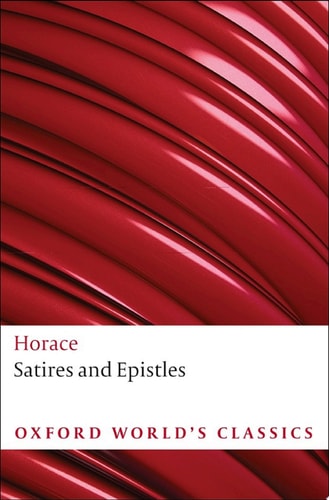
Satires and Epistles
0
0
As an Amazon Associate and affiliate partner, Menrva Books earns from qualifying purchases. Learn more
Author Description
What's the harm in using humour to put across what is true? Gluttony, lust, and hypocrisy are just a few of the targets of Horace's Satires. Writing in the 30s BC, Horace exposes the vices and follies of his Roman contemporaries, while still finding time to reflect on how to write good satire and along the way revealing his own persona to be as flawed and bigoted as the people he attacks. Alongside famous episodes such as the fable of the town mouse and the country mouse, the explosive fart of Priapus, and the grotesque dinner party given by the nouveau-riche Nasidienus, these poems are stuffed full of comic vignettes, moral insights, and Horace's pervasive humanity. They influenced not only Persius and Juvenal but the long tradition of English satire, from Ben Jonson to W. H. Auden. These new prose translations by John Davie perfectly capture the ribald style of the original. In the Epistles, Horace uses the form of letters to his friends, acquaintances, foremen, and even the emperor to explore questions of philosophy and how to live a good life; and in 'The Art of Poetry' (the Ars poetica), he gives advice on poetic style that informed the work of writers and dramatists for centuries. ABOUT THE SERIES: For over 100 years Oxford World's Classics has made available the widest range of literature from around the globe. Each affordable volume reflects Oxford's commitment to scholarship, providing the most accurate text plus a wealth of other valuable features, including expert introductions by leading authorities, helpful notes to clarify the text, up-to-date bibliographies for further study, and much more.
Menrva's Summary
THE PULSE
Horace utilizes the biting wit of satire and the reflective nature of the epistle to critique the moral failings of Roman society while simultaneously examining his own personal flaws. Through a series of poetic vignettes, the author navigates the tension between public vice and private virtue, employing a conversational tone that bridges the gap between the poet and his audience. The work functions as both a social mirror and a philosophical manual, structured through a mix of observational humor and direct address to contemporaries. The narrative framework relies on the persona of the poet, who positions himself as a fallible observer within a world defined by gluttony, hypocrisy, and the pursuit of status.
INSIDE THE PAGES
- Use of the epistolary format to address friends and public figures
- Inclusion of iconic fables such as the town mouse and the country mouse
- Integration of ribald humor and grotesque character sketches
- Exploration of the mechanics and ethics of satirical writing
- Philosophical inquiries into the nature of a well-lived life
- Meta-commentary on poetic style and literary composition
- Direct social critique of Roman contemporary vices
- Application of a conversational, accessible prose translation style
THE COLLECTIVE ECHO
Readers and critics frequently note the enduring influence of these poems on the Western satirical tradition, citing their impact on writers from Ben Jonson to W. H. Auden. Discussion often centers on the balance between Horace's sharp social commentary and his self-deprecating, often flawed persona. The accessibility of the prose translation is frequently highlighted as a key factor in making these ancient texts relevant to modern audiences. Scholars emphasize the importance of the Ars poetica as a foundational text for understanding the evolution of literary theory and poetic structure.
Page Count:
205
Publication Date:
2011-01-01
Publisher:
OUP Oxford
ISBN-10:
0191620157
ISBN-13:
9780191620157
Poetry
Philosophy
Satire
English & College Success
English
Roman History
Classical
Community Tags
Similar Books