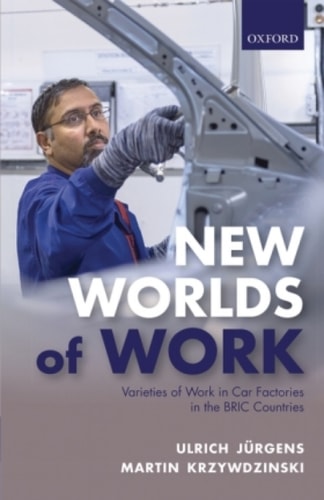
New Worlds of Work: Varieties of Work in Car Factories in the BRIC Countries
0
0
As an Amazon Associate and affiliate partner, Menrva Books earns from qualifying purchases. Learn more
Author Description
New industrial centres are emerging in the so-called BRIC countries (Brazil, Russia, India, and China), where large numbers of plants have been constructed in recent years, creating many manufacturing jobs. But what does industrial work look like in these locations? Up until now, much of the interest in developing country industrialization has concentrated on the poor working conditions that characterize some export-oriented sectors in emerging economies, most notoriously in the garment industry. In contrast, the concern of this book is with the modern facilities of multinational or local manufacturers that reflect aspirations for a process of industrial upgrading that might foreshadow the future for these countries. The book provides an analysis of work, its context, and the situation of employees in plants in the BRICs focussing on three main questions: What differences and common features can be ascertained in a comparison both of countries and firms in terms of workplace HR management and production systems? What evidence is there for either a 'high road' or 'low road' developmental path in the BRICs? How are corporate standards implemented in these local contexts? The book addresses an academic audience as well as managers and trade unionists. For the former, it offers a systematic comparison of the four countries and the companies under study. For the latter, it offers a vivid account of challenges the companies face in the BRIC countries as well as the solutions adopted by the companies.
Menrva's Summary
THE THESIS
This book investigates how modern industrial work is organized and managed within the automotive sectors of Brazil, Russia, India, and China. Authors Martin Krzywdzinski and Ulrich Jürgens utilize a comparative framework to analyze whether these emerging economies are pursuing a high-road or low-road developmental path. By examining the intersection of multinational corporate standards and local labor contexts, the authors assess the reality of industrial upgrading in these rapidly developing regions.
THE SCOPE MAP
What You Will Find
- Comparative analysis of HR management and production systems across four distinct national contexts.
- Evaluation of corporate standard implementation in local manufacturing plants.
- Assessment of developmental trajectories regarding labor conditions and industrial efficiency.
Scope Limits
- The analysis is restricted to the automotive manufacturing sector and does not cover other industrial fields.
- The study focuses on modern, large-scale facilities rather than informal or small-scale export-oriented sectors.
THE AUTHORITY PERSPECTIVE
Experts identify this work as a rigorous comparative study that provides necessary nuance to the discourse on industrialization in emerging markets. Readers frequently note the academic density of the prose, which serves as a valuable resource for scholars, policy analysts, and labor relations professionals.
Page Count:
336
Publication Date:
2016-01-01
Publisher:
OUP Oxford
ISBN-10:
0191034231
ISBN-13:
9780191034237
Economics
Automobile Industry And Trade
Labor Studies
BRIC Countries
Corporate governance
Manufacturing
International business
Industrial Sociology
Community Tags
Similar Books