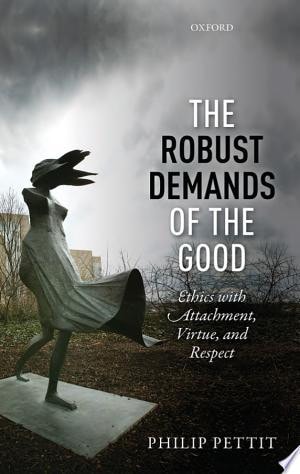
The Robust Demands of the Good
0
0
As an Amazon Associate and affiliate partner, Menrva Books earns from qualifying purchases. Learn more
Author Description
Some goods that we generate for others, as when we give them attention or help or encouragement, require us to provide that benefit under the actual circumstances where we interact. Other goods that we generate require not just that we actually provide that sort of benefit but that we are also poised to provide it, even should actual circumstances change in various ways. These goods demand robust and not merely actual beneficence. Thus to give you friendship I must be robustly, not just accidentally, attentive to your needs; to give you a virtue like honesty I must be robustly disposed to tell you the truth; and to give you respect I must be robustly committed to showing restraint in my dealings with you. In this original contribution to normative ethics, Philip Pettit charts the range of robustly demanding goods, building on his earlier work on the robust demands of freedom. He explores the rationale behind our concern for being able to rely on others to treat us well, not just for being lucky enough to enjoy good treatment. And then he traces the implications for ethics of giving a central place to robustly demanding goods. The lessons he draws teach us that there is a tighter connection between being good and doing good than is generally recognized; that it is harder to count as doing good than it is to count as doing evil; and that there is a serious issue, ignored in many ethical theories, about the basis on which we should deliberate in day-to-day decisions about what it is right to do. The book amounts to a radical rethinking of ethics in which many standard positions shift or fall. The association between being good and doing good casts doubt on the orthodox dichotomy between evaluating agents and evaluating actions. The calibration between doing good and doing evil explains the Knobe effect, so called, as well as explaining the superficial appeal of doctrines like that of double effect. And the investigation of how to be guided in deliberating about the right.
Menrva's Summary
THE THESIS
This work investigates the moral necessity of 'robust' beneficence, arguing that true ethical goods require a consistent disposition to act well across varying circumstances rather than merely accidental or situational kindness. Philip Pettit, a prominent philosopher, utilizes his established framework regarding the demands of freedom to construct a new normative ethical theory. He examines the human need for reliable, predictable treatment from others and argues that traditional ethical theories often overlook the importance of this robust commitment in our daily moral deliberations.
THE SCOPE MAP
What You Will Find
- A conceptual framework for distinguishing between actual and robust beneficence
- An analysis of the Knobe Effect and its implications for moral psychology
- A critique of the standard dichotomy between evaluating agents versus evaluating actions
Scope Limits
- The text does not provide a comprehensive history of all normative ethical schools
- It does not offer a practical 'how-to' guide for personal moral decision-making in non-philosophical contexts
THE AUTHORITY PERSPECTIVE
Experts recognize this text as a significant contribution to contemporary normative ethics that challenges established orthodoxies. Readers frequently note the high level of academic density and the rigorous logical structure required to follow Pettit's arguments.
Page Count:
256
Publication Date:
2015-01-01
Publisher:
Oup Oxford
ISBN-10:
0191046590
ISBN-13:
9780191046599
Philosophy
Normative Ethics
Ethics
Moral Philosophy
Social Philosophy
Community Tags
Similar Books