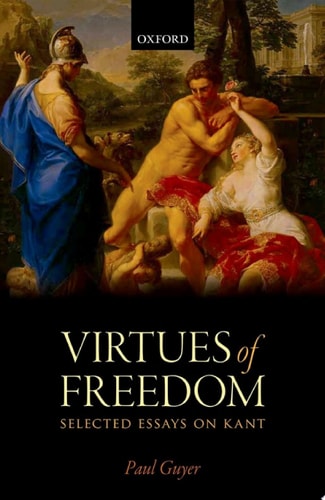
The Virtues of Freedom: Selected Essays on Kant
0
0
As an Amazon Associate and affiliate partner, Menrva Books earns from qualifying purchases. Learn more
Author Description
The essays collected in this volume by Paul Guyer, one of the world's foremost Kant scholars, explore Kant's attempt to develop a morality grounded on the intrinsic and unconditional value of the human freedom to set our own ends. When regulated by the principle that the freedom of all is equally valuable, the freedom to set our own ends - what Kant calls "humanity"--Becomes what he calls autonomy. These essays explore Kant's strategies for establishing the premise that freedom is the inner worth of the world or the essential end of humankind, as he says, and for deriving the specific duties that fundamental principle of morality generates in the empirical circumstances of human existence. 'The Virtues of Freedom' further investigates Kant's attempts to prove that we are always free to live up to this moral ideal, that is, that we have free will no matter what, as well as his more successful explorations of the ways in which our natural tendencies to be moral - dispositions to the feeling of respect and more specific feelings such as love and self-esteem - can and must be cultivated and educated. Guyer finally examines the various models of human community that Kant develops from his premise that our associations must be based on the value of freedom for all. The contrasts but also similarities of Kant's moral philosophy to that of David Hume but many of his other predecessors and contemporaries, such as Stoics and Epicureans, Pufendorf and Wolff, Hutcheson, Kames, and Smith, are also explored.
Menrva's Summary
THE THESIS
This collection investigates how Immanuel Kant establishes human freedom as the foundational principle of morality and the essential end of human existence. Paul Guyer, a prominent Kantian scholar, utilizes a rigorous analytical framework to examine how Kant derives specific moral duties from the concept of autonomy. The essays synthesize Kant's arguments regarding free will, the cultivation of moral dispositions, and the development of community models based on the equal value of individual freedom.
THE SCOPE MAP
What You Will Find
- Analysis of Kant's moral philosophy and the concept of autonomy
- Investigations into the relationship between free will and moral obligation
- Comparative studies between Kant and predecessors like Hume, the Stoics, and the Epicureans
- Examination of the role of natural dispositions such as respect, love, and self-esteem in moral education
Scope Limits
- The text focuses primarily on Kant's moral and political philosophy rather than his metaphysical or aesthetic works
- It does not provide a comprehensive biography of Kant, focusing instead on thematic essay analysis
THE AUTHORITY PERSPECTIVE
Experts recognize this collection as a significant contribution to Kantian scholarship, particularly for its clarity in connecting abstract moral principles to empirical human existence. Readers frequently note the academic density of the prose, which is best suited for those already familiar with the foundational texts of Enlightenment philosophy.
Page Count:
337
Publication Date:
2016-01-01
Publisher:
Oxford University Press
ISBN-10:
0191831824
ISBN-13:
9780191831829
Philosophy
Political Philosophy
Moral Philosophy
Ethics
Kant