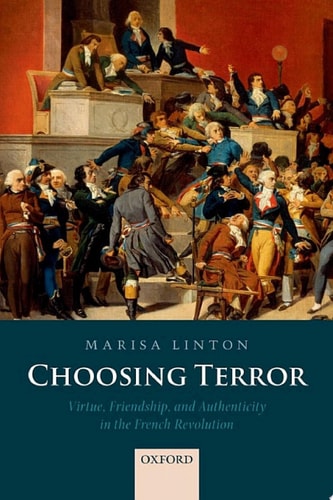
Choosing Terror: Virtue, Friendship, and Authenticity in the French Revolution
0
0
As an Amazon Associate and affiliate partner, Menrva Books earns from qualifying purchases. Learn more
Author Description
Choosing Terror: Virtue, Friendship and Authenticity in the French Revolution examines the leaders of the French Revolution - Robespierre and his fellow Jacobins - and particularly the gradual process whereby many of them came to 'choose terror'. These men led the Jacobin Club between 1789 and 1794, and were attempting to establish new democratic politics in France. Exploring revolutionary politics through the eyes of these leaders, and against a political backdrop of a series of traumatic events, wars, and betrayals, Marisa Linton portrays the Jacobins as complex human beings who were influenced by emotions and personal loyalties, as well as by their revolutionary ideology. The Jacobin leaders' entire political careers were constrained by their need to be seen by their supporters as 'men of virtue', free from corruption and ambition, and concerned only with the public good. In the early stages of the Revolution, being seen as 'men of virtue' empowered the Jacobin leaders, and aided them in their efforts to forge their political careers. However, with the onset of war, there was a growing conviction that political leaders who feigned virtue were 'the enemy within', secretly conspiring with France's external enemies. By Year Two, the year of the Terror, the Jacobin identity had become a destructive force: in order to demonstrate their own authenticity, they had to be seen to act virtuously, and be prepared, if the public good demanded it, to denounce and destroy their friends, and even to sacrifice their own lives. This desperate thinking resulted in the politicians' terror, one of the most ruthless of all forms of terror during the Revolution. Choosing Terror seeks neither to cast blame, nor to exonerate, but to understand the process whereby such things can happen.
Menrva's Summary
THE THESIS
This work investigates the psychological and political mechanisms that led Jacobin leaders, including Maximilien Robespierre, to adopt state-sanctioned terror as a necessary instrument of governance during the French Revolution. Marisa Linton, a historian specializing in 18th-century France, utilizes primary source documents, personal correspondence, and political records to analyze how the performative requirement of 'virtue' constrained the decision-making processes of revolutionary elites. The author argues that the intersection of personal friendship, public perception, and the existential threat of war created a feedback loop that normalized political violence as a proof of authenticity.
THE SCOPE MAP
What You Will Find
- Analysis of the Jacobin Club's internal political culture between 1789 and 1794.
- Examination of the concept of 'virtue' as a political currency in revolutionary France.
- Case studies on the shifting loyalties and betrayals among key revolutionary figures.
- Historical context regarding the impact of external wars on domestic policy.
Scope Limits
- The text does not provide a comprehensive military history of the French Revolutionary Wars.
- It does not focus on the experiences of the general populace or non-Jacobin political factions.
THE AUTHORITY PERSPECTIVE
Historians and scholars frequently cite this work for its nuanced psychological approach to political history, noting that it successfully moves beyond traditional ideological interpretations of the Terror. Readers often highlight the academic rigor of the prose, which provides a detailed look at the internal pressures faced by revolutionary leaders.
Page Count:
329
Publication Date:
2015-01-01
Publisher:
OUP Oxford
ISBN-10:
0191057002
ISBN-13:
9780191057007
Biography
History
French Revolution
Jacobins
18th century
European History
Community Tags
Other Editions(2)
Similar Books






Reader Comments
Share Your Thoughts
No comments yet. Be the first to share your thoughts!