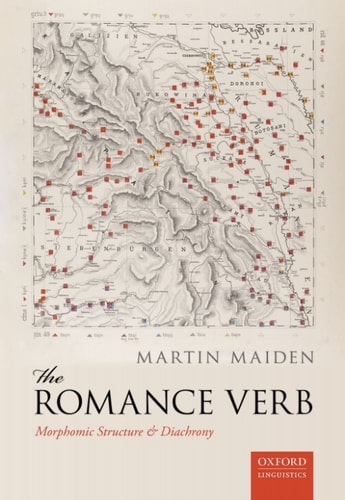
The Romance Verb: Morphomic Structure and Diachrony
0
0
As an Amazon Associate and affiliate partner, Menrva Books earns from qualifying purchases. Learn more
Author Description
This book is the first comprehensive comparative-historical survey of patterns of alternation in the Romance verb which appear to be 'autonomously morphological': although they can be shown to be persistent through time, they have long ceased to be conditioned by any phonological or functional determinant. Some of these patterns are well known in Romance linguistics, while others have scarcely been noticed. The sheer range of phenomena which participate in these patterns in any case far surpasses what Romance linguists had previously realized. The patterns constitute a kind of abstract 'leitmotiv', running through the history of the Romance languages and conferring on them a distinctive morphological physiognomy. Although intended primarily as a novel contribution to comparative-historical Romance linguistics, the book considers in detail the status of these patterns which appear to be a matter of 'morphology by itself', unsupported by determining factors external to the morphological system. Particular attention is paid to the problem of their persistence, self-replication, and reinforcement over time. Why do abstract morphological patterns that quite literally 'do not make sense' display such diachronic robustness? The evidence suggests that speakers, faced with different ways of expressing semantically identical material, seek out distributional templates into which those differences can be deployed. In Romance the only available templates happen to be 'morphomic', morphologically accidental, effects of old sound changes or defunct functional conditionings. Those patterns are accordingly exploited, and indeed reinforced, by being made maximally predictable.
Menrva's Summary
THE THESIS
This book investigates why abstract, non-functional morphological patterns in Romance verbs persist and replicate over centuries despite lacking clear phonological or semantic determinants. Martin Maiden, a specialist in Romance linguistics, utilizes a comparative-historical framework to analyze these 'morphomic' structures. He argues that speakers actively seek out distributional templates to organize linguistic material, inadvertently reinforcing these arbitrary patterns to achieve greater predictability within the morphological system.
THE SCOPE MAP
What You Will Find
- Comparative analysis of verb alternation patterns across various Romance languages
- Examination of 'morphology by itself' as an autonomous system
- Theoretical exploration of diachronic robustness in linguistic structures
Scope Limits
- Does not provide a general grammar of Romance languages
- Does not focus on syntax or semantics outside of their relation to morphological templates
THE AUTHORITY PERSPECTIVE
Experts recognize this work as a foundational text for understanding the autonomous nature of morphological change in Romance philology. Readers frequently note the academic density of the prose, which is intended for advanced students and professional linguists.
Page Count:
384
Publication Date:
2018-01-01
Publisher:
OUP Oxford
ISBN-10:
0191056391
ISBN-13:
9780191056390
English
Historical linguistics
Philology
Morphology
Linguistics
English & College Success
Community Tags
Similar Books