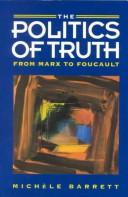
The Politics of Truth
0
0
As an Amazon Associate and affiliate partner, Menrva Books earns from qualifying purchases. Learn more
Author Description
The concept of ideology--traditionally one of Marxism's most persuasive ideas--has recently been subjected to devastating criticisms. Michele Barrett shows that Marx's own writings offer a confusing array of possible approaches to 'ideology', which the classical Marxist tradition consolidated as 'mystification that serves class interests'. Barrett locates Gramsci and Althusser as key figures in the breakdown of this model--Gramsci's work presaging the separation of class, politics and ideology found in Laclau and Mouffe, and Althusser's failing to deliver an adequate approach to subjectivity. Foucault--replacing Marxism's 'economics of untruth' with his own 'politics of truth'--is examined as an exemplar of post-structuralist critiques of ideology. The book ranges over contemporary debates in philosophy, psychoanalysis and literary theory as well as social theory. Marxism's theoretical universalism, ethnocentrism and gender blindness, as well as its influential term 'ideology', are all subjected to spirited criticism.
Menrva's Summary
THE THESIS
This book critically examines the concept of ideology, particularly within Marxist thought, and its subsequent critiques from post-structuralist perspectives. Michele Barrett, drawing on her background in literary and social theory, analyzes the evolution of the concept of ideology from Marx through key figures like Gramsci, Althusser, and Foucault. The book investigates the limitations of traditional Marxist approaches to ideology, particularly concerning subjectivity and class interests, and explores Foucault's alternative 'politics of truth'. It engages with contemporary debates across philosophy, psychoanalysis, and literary theory to offer a spirited critique of Marxism's theoretical universalism, ethnocentrism, and gender blindness.
THE SCOPE MAP
- Analysis of the concept of ideology in Marx's writings and its consolidation in classical Marxism.
- Examination of Gramsci's and Althusser's contributions and limitations in Marxist ideology theory.
- Exploration of Foucault's 'politics of truth' as a post-structuralist critique of ideology.
- Discussion of contemporary debates in philosophy, psychoanalysis, and literary theory.
- Critique of Marxism's theoretical universalism, ethnocentrism, and gender blindness.
THE AUTHORITY PERSPECTIVE
The book is recognized for its rigorous engagement with complex theoretical debates surrounding ideology and its critique of traditional Marxist frameworks. It is noted for its detailed analysis of key thinkers such as Gramsci, Althusser, and Foucault, offering a nuanced perspective on the evolution of these concepts. The work is appreciated for its interdisciplinary approach, drawing connections across philosophy, psychoanalysis, and literary theory. Its spirited critique of Marxism's inherent biases makes it a significant contribution to social and political theory.
Page Count:
194
Publication Date:
1991-01-01
ISBN-10:
0804720045
ISBN-13:
9780804720045
Politics
Science
Non-Fiction
Philosophy
History
Social Theory
Literary theory
Political Theory
Community Tags
Similar Books