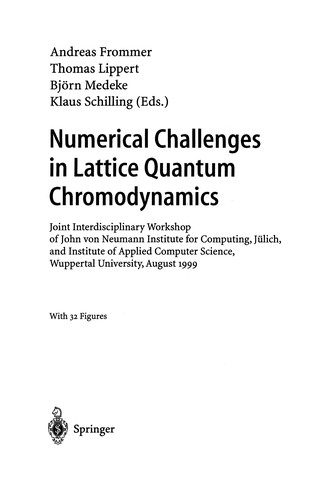
Numerical Challenges in Lattice Quantum Chromodynamics
0
0
As an Amazon Associate and affiliate partner, Menrva Books earns from qualifying purchases. Learn more
Author Description
The book with contributions from the joint interdisciplinary workshop covers important numerical bottleneck problems from lattice quantum chromodynamics: 1) The computation of Green's functions from huge sparse linear systems and the determination of flavor-singlet observables by stochastic estimates of matrix traces can both profit from novel preconditioning techniques and algebraic multi-level algorithms. 2) The exciting overlap fermion formulation requires the solution of linear systems including a matrix sign function, an extremely demanding numerical task that is tackled by Lanczos/projection methods. 3) Realistic simulations of QCD must include three light dynamical quark flavors with non-degenerate masses. Algorithms using polynomial approximations of the matrix determinant can deal with this situation. The volume aims at stimulating synergism and creating new links between lattice quantum and numerical analysis.
Menrva's Summary
THE THESIS
The book addresses critical numerical challenges in lattice quantum chromodynamics (QCD) by exploring advanced computational techniques. It focuses on three key areas: solving large sparse linear systems for Green's function computation and stochastic estimates of matrix traces using preconditioning and multi-level algorithms; tackling the demanding task of solving linear systems with overlap fermions via Lanczos/projection methods; and managing realistic QCD simulations with three light dynamical quark flavors using polynomial approximations for matrix determinants. The volume seeks to foster collaboration between lattice QCD researchers and numerical analysts.
THE SCOPE MAP
- Computation of Green's functions from large sparse linear systems.
- Determination of flavor-singlet observables via stochastic estimates of matrix traces.
- Application of novel preconditioning techniques and algebraic multi-level algorithms.
- Solution of linear systems involving overlap fermion formulations.
- Utilization of Lanczos/projection methods for matrix sign function problems.
- Simulation of QCD with three light dynamical quark flavors.
- Algorithms employing polynomial approximations of the matrix determinant.
- Stimulating synergism between lattice quantum chromodynamics and numerical analysis.
THE AUTHORITY PERSPECTIVE
This volume, stemming from a joint interdisciplinary workshop, presents a focused collection of numerical challenges within lattice quantum chromodynamics. The contributions highlight specific computational bottlenecks and propose advanced algorithmic solutions, such as preconditioning techniques, multi-level algorithms, and polynomial approximations. The work is structured to encourage new connections and collaborations between the fields of lattice QCD and numerical analysis, suggesting a readership of specialists in these areas. The emphasis is on the technical aspects of solving complex problems in theoretical physics through advanced computational methods.
Page Count:
184
Publication Date:
2000-01-01
ISBN-10:
3642583334
ISBN-13:
9783642583339
Science
Non-Fiction
Physics
Computational Physics
Community Tags
Similar Books