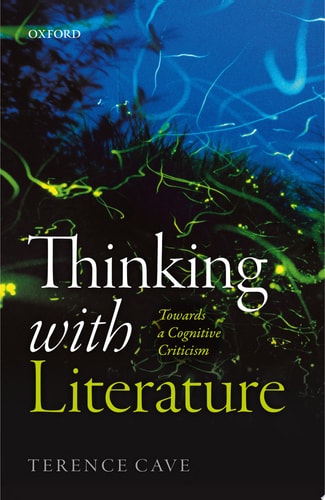
Thinking with Literature: Towards a Cognitive Criticism
0
0
As an Amazon Associate and affiliate partner, Menrva Books earns from qualifying purchases. Learn more
Author Description
To speak of 'thinking with literature' is to make the assumption that literature (in the broadest sense) is neither a side-show nor a side-issue in human cultures: it belongs to the spectrum of imaginative modes that includes both philosophical and scientific thought. Whether one regards it as a practice or as an archive, literature is highly pervasive, robust, enduring, and pregnant with values. Thinking with Literature argues that what it affords above all is a way of thinking, whether for writer, reader, or critic. Literature constitutes one of the prime instruments of cultural improvisation; it is the embodiment of a powerful, inventive, and ever-changing cognitive agency. As such, it invites a cognitive mode of criticism, one which asserts the priority of the individual literary work as a unique product of human cognition. In this book, discussions of topics, arguments, and hypotheses from the cognitive sciences, philosophy, and the theory of communication are woven into the fabric of a critical analysis which insists on the value of close reading: a poem by Yeats, a scene from Shakespeare, novels by Mme de Lafayette, Conrad, Frantzen, stories from Winnie-the-Pooh, and many others appear here on their own terms, with their own cognitive energies. Written in an accessible style, Thinking with Literature speaks both to mainstream readers of literature and to specialists in cognitive studies.
Menrva's Summary
THE THESIS
This book investigates the proposition that literature functions as a primary instrument of human cognition, operating alongside philosophical and scientific modes of thought. Terence Cave, a scholar of French literature and comparative studies, utilizes a framework that bridges the gap between cognitive science and traditional literary analysis. He argues that literary works are not merely cultural artifacts but are active, inventive agents of thought that require a specific cognitive mode of criticism to fully understand their unique contributions to human understanding.
THE SCOPE MAP
What You Will Find
- A theoretical framework for cognitive criticism that emphasizes the individual literary work.
- Interdisciplinary synthesis of cognitive science, communication theory, and philosophy.
- Close readings of diverse texts ranging from Shakespeare and Yeats to Winnie-the-Pooh.
Scope Limits
- The book does not provide a comprehensive history of cognitive science or literary theory.
- It does not attempt to reduce literary value to purely neurological or biological functions.
THE AUTHORITY PERSPECTIVE
Scholars and critics recognize this work as a significant contribution to the field of cognitive poetics, noting its ability to balance complex theoretical arguments with accessible prose. Readers frequently highlight the author's success in demonstrating how close reading remains a vital tool even when integrated with scientific and philosophical inquiry.
Page Count:
222
Publication Date:
2016-01-01
Publisher:
OUP Oxford
ISBN-10:
0191066362
ISBN-13:
9780191066368
Philosophy
English & College Success
Literary theory
Literature
Literary Criticism
Cognition
English
Community Tags
Similar Books