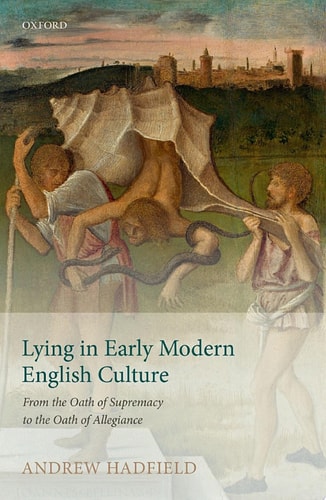
Lying in Early Modern English Culture: From the Oath of Supremacy to the Oath of Allegiance
0
0
As an Amazon Associate and affiliate partner, Menrva Books earns from qualifying purchases. Learn more
Author Description
Lying in Early Modern English Culture is a major study of ideas of truth and falsehood in early modern England from the advent of the Reformation to the aftermath of the failed Gunpowder Plot. The period is characterised by panic and chaos when few had any idea how religious, cultural, and social life would develop after the traumatic division of Christendom. While many saw the need for a secular power to define the truth others declared that their allegiances belonged elsewhere. Accordingly there was a constant battle between competing authorities for the right to declare what was the truth and so label opponents as liars. Issues of truth and lying were, therefore, a constant feature of everyday life and determined ideas of individual identity, politics, speech, sex, marriage, and social behaviour, as well as philosophy and religion. This book is a cultural history of truth and lying from the 1530s to the 1610s, showing how lying needs to be understood in action as well as in theory. Unlike most histories of lying, it concentrates on a series of particular events reading them in terms of academic theories and more popular notions of lying. The book covers a wide range of material such as the trials of Ann Boleyn and Thomas More, the divorce of Frances Howard, and the murder of Anthony James by Annis and George Dell; works of literature such as Othello, The Faerie Queene, A Mirror for Magistrates, and The Unfortunate Traveller; works of popular culture such as the herring pamphlet of 1597; and major writings by Castiglione, Montaigne, Erasmus, Luther, and Tyndale.
Menrva's Summary
THE THESIS
This book investigates how the concepts of truth and falsehood functioned as central mechanisms of social, political, and religious control in England between the 1530s and the 1610s. Andrew David Hadfield, a scholar specializing in early modern literature and culture, utilizes a multidisciplinary framework to analyze how the Reformation and subsequent political instability forced individuals to navigate competing claims of authority. By examining the intersection of legal trials, literary texts, and popular pamphlets, the author argues that lying was not merely a theoretical concern but a practical, performative act that defined individual identity and social behavior during a period of profound national anxiety.
THE SCOPE MAP
What You Will Find
- Analysis of legal and political events including the trials of Anne Boleyn and Thomas More.
- Examination of literary works by authors such as Shakespeare, Spenser, and Nashe.
- Integration of philosophical and theological perspectives from Erasmus, Luther, and Montaigne.
- Case studies on the impact of the Oath of Supremacy and the Oath of Allegiance.
Scope Limits
- The study is strictly confined to the period between the 1530s and the 1610s.
- The analysis focuses primarily on English cultural and political contexts rather than continental European developments in isolation.
THE AUTHORITY PERSPECTIVE
Scholars recognize this work as a significant contribution to the cultural history of early modern England, particularly for its ability to bridge the gap between high-level political theory and everyday social practice. Readers frequently note the academic density of the prose, which makes it a valuable resource for researchers interested in the intersection of rhetoric, law, and identity in the sixteenth and seventeenth centuries.
Page Count:
384
Publication Date:
2017-01-01
Publisher:
OUP Oxford
ISBN-10:
0192506595
ISBN-13:
9780192506597
History
Philosophy
Religion
English & College Success
English
Cultural History
Early Modern
Political History
Great Britain
Truthfulness and falsehood