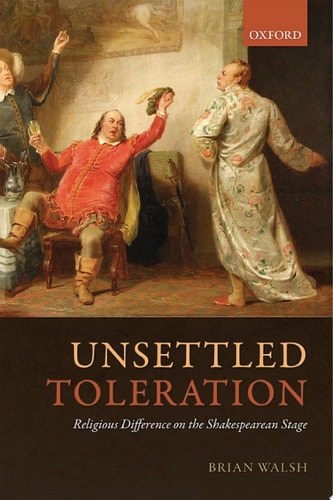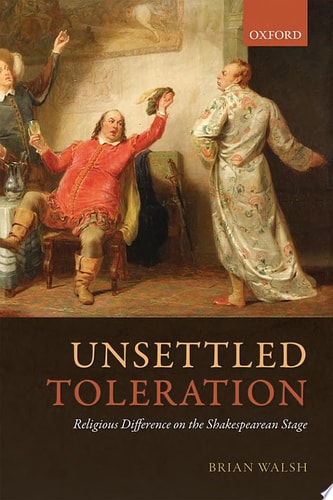
Unsettled Toleration: Religious Difference on the Shakespearean Stage
0
0
As an Amazon Associate and affiliate partner, Menrva Books earns from qualifying purchases. Learn more
Author Description
Unsettled Toleration: Religious Difference On The Shakespearean Stage Historicizes And Scrutinizes The Unstable Concept Of Toleration As It Emerges In Drama Performed On The Elizabethan And Jacobean Stages. Brian Walsh Examines Plays By Shakespeare And His Contemporaries That Represent Intra-christian Conflict Between Mainstream Believers And Various Minorities, Analyzing The Sometimes Explicit, Sometimes Indirect, Occasionally Smooth, But More Often Halting And Equivocal Forms Of Dealing With Difference That These Plays Imagine Can Result From Such Exchanges. Through Innovative And In Some Cases Unprecedented Readings Of A Diverse Collection Of Plays, From Chapman's An Humorous Day's Mirth, Middleton's The Puritan Widow, Shakespeare's Twelfth Night, Measure For Measure, And Pericles, And Rowley's When You See Me You Know Me, Walsh Shows How The English Stage In The First Decade Of The Seventeenth Century, As A Social Barometer, Registered The Basic Condition Of Religious Unsettlement Of The Post-reformation Era; And Concurrently That The Stage, As A Social Incubator, Brooded Over Imagined Scenarios Of Confessional Conflict That Could End Variously In Irresolution, Accommodation, Or Even Religious Syncretism. It Thus Helped To Create, Sustain And Enlarge An Open-ended Public Conversation On The Vicissitudes Of Getting Along In A Sectarian World. Attending To This Conversation Is Vital To Our Present Understanding Of The State Of Religious Toleration The Early Modern Period, For It Gives A Fuller Picture Of The Ways Religious Difference Was Experienced Than The Limited And Inert Pronouncements On The Topic That Officials Of The Church And State Offered.
Menrva's Summary
THE THESIS
This book investigates how early modern English drama functioned as both a social barometer and an incubator for the unstable, evolving concept of religious toleration in the post-Reformation era. Brian Walsh, a scholar of early modern literature, utilizes a historical framework to analyze how playwrights represented intra-Christian conflict. He argues that the stage provided a space for exploring complex, often irresolute scenarios of religious difference that official state and church pronouncements failed to capture.
THE SCOPE MAP
What You Will Find
- Analysis of plays by Shakespeare, Chapman, Middleton, and Rowley.
- Examination of the social and political climate of the early seventeenth century.
- Theoretical framework regarding the stage as a site for public discourse on sectarianism.
Scope Limits
- The study focuses specifically on the first decade of the seventeenth century.
- It does not provide a comprehensive history of religious legislation or formal theological doctrine.
THE AUTHORITY PERSPECTIVE
Scholars and students of early modern drama frequently cite this work for its nuanced approach to the intersection of theater and religious history. Experts highlight the text as a significant contribution to understanding how cultural artifacts reflect and shape societal attitudes toward religious difference.
Page Count:
256
Publication Date:
2016-01-01
Publisher:
Oxford University Press
ISBN-10:
0191069396
ISBN-13:
9780191069390
Drama
History
Early Modern
Shakespearean Studies
Literary Criticism