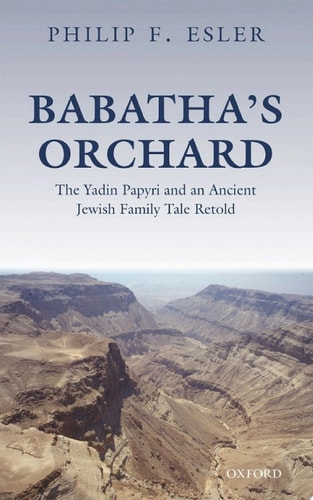
Babatha's Orchard: The Yadin Papyri and an Ancient Jewish Family Tale Retold
0
0
As an Amazon Associate and affiliate partner, Menrva Books earns from qualifying purchases. Learn more
Author Description
In 1961 archaeologists discovered a family archive of legal papyri in a cave near the Dead Sea where their owner, the Jewish woman Babatha, had hidden them in 135 CE at the end of the Bar Kokhba revolt. Babatha's Orchard analyzes the oldest four of these papyri to argue that underlying them is a hitherto undetected and surprising train of events concerning how Babatha's father, Shim'on, purchased a date-palm orchard in Maoza on the southern shore of the Dead Sea in 99 CE that he later gave to Babatha. The central features of the story, untold for two millennia, relate to how a high Nabatean official had purchased the orchard only a month before, but suddenly rescinded the purchase, and how Shim'on then acquired it, in enlarged form, from the vendor. Teasing out the details involves deploying the new methodology of archival ethnography, combined with a fresh scrutiny of the papyri (written in Nabatean Aramaic), to investigate the Nabatean and Jewish individuals mentioned and their relationships within the social, ethnic, economic, and political realities of Nabatea at that time. Aspects of this context which are thrown into sharp relief by Babatha's Orchard include: the prominence of wealthy Nabatean women and their husbands' financial reliance on them; the high returns and steep losses possible in date cultivation; the sophistication of Nabatean law and lawyers; the lingering effect of the Nabateans' nomadic past in lessening the social distance between elite and non-elite; and the good ethnic relations between Nabateans and Jews.
Menrva's Summary
THE THESIS
This book investigates the legal and social history embedded within the oldest four papyri of the Babatha archive to reconstruct the acquisition of a date-palm orchard in 99 CE. Philip F. Esler, a scholar specializing in the social-scientific study of the New Testament and early Judaism, utilizes the methodology of archival ethnography to interpret these documents. By scrutinizing the Nabatean Aramaic texts, he argues that the purchase of the orchard by Babatha's father, Shim'on, reveals complex interactions between Nabatean officials and Jewish families during a period of significant regional transition.
THE SCOPE MAP
What You Will Find
- A detailed analysis of four specific legal papyri from the Yadin archive.
- An application of archival ethnography to ancient legal documents.
- Insights into the economic realities of date cultivation in the Dead Sea region.
- Examination of social dynamics, including gender roles and ethnic relations between Nabateans and Jews.
Scope Limits
- The study is primarily focused on the specific transactions surrounding the orchard and does not provide a comprehensive history of the entire Bar Kokhba revolt.
- The analysis is constrained by the surviving textual evidence within the selected papyri.
THE AUTHORITY PERSPECTIVE
Scholars and historians recognize this work as a rigorous application of social-scientific methods to ancient legal archives. Readers frequently note the academic density of the prose, which serves to provide a granular look at the economic and social structures of the Nabatean period.
Page Count:
300
Publication Date:
2017-01-01
Publisher:
OUP Oxford
ISBN-10:
0191079901
ISBN-13:
9780191079900
History
Archaeology
Ancient History
Jewish History
Manuscripts
Legal History
Middle Eastern
Jews
Community Tags
Similar Books