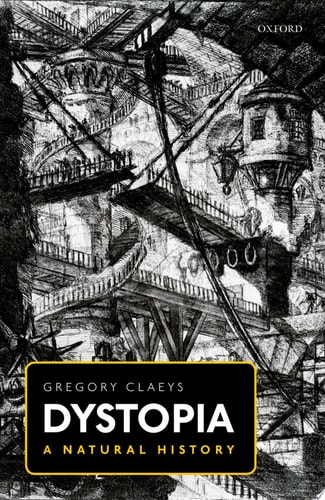
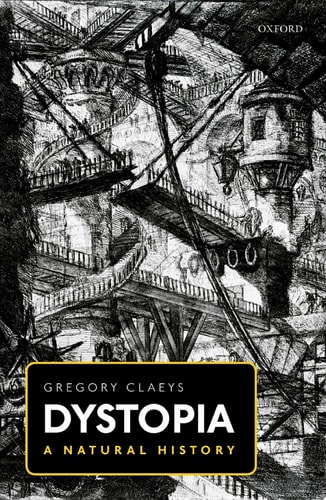
Dystopia: A Natural History
0
0
As an Amazon Associate and affiliate partner, Menrva Books earns from qualifying purchases. Learn more
Author Description
Dystopia: A Natural History is the first monograph devoted to the concept of dystopia. Taking the term to encompass both a literary tradition of satirical works, mostly on totalitarianism, as well as real despotisms and societies in a state of disastrous collapse, this volume redefines the central concepts and the chronology of the genre and offers a paradigm-shifting understanding of the subject. Part one assesses the theory and prehistory of 'dystopia'. By contrast to utopia, conceived as promoting an ideal of friendship defined as 'enhanced sociability', dystopia is defined by estrangement, fear, and the proliferation of 'enemy' categories. A 'natural history' of dystopia thus concentrates upon the centrality of the passion or emotion of fear and hatred in modern despotisms. The work of Le Bon, Freud, and others is used to show how dystopian groups use such emotions. Utopia and dystopia are portrayed not as opposites, but as extremes on a spectrum of sociability, defined by a heightened form of group identity. The prehistory of the process whereby 'enemies' are demonised is explored from early conceptions of monstrosity through Christian conceptions of the devil and witchcraft, and the persecution of heresy. Part two surveys the major dystopian moments in twentieth century despotisms, focussing in particular upon Nazi Germany, Stalinism, the Chinese Cultural Revolution, and Cambodia under Pol Pot. The concentration here is upon the political religion hypothesis as a key explanation for the chief excesses of communism in particular. Part three examines literary dystopias. It commences well before the usual starting-point in the secondary literature, in anti-Jacobin writings of the 1790s. Two chapters address the main twentieth-century texts usually studied as representative of the genre, Aldous Huxley's Brave New World and George Orwell's Nineteen Eighty-four. The remainder of the section examines the evolution of the genre in the second half of the twentieth century.
Menrva's Summary
THE THESIS
This volume investigates the conceptual origins and historical manifestations of dystopia, arguing that it functions as a spectrum of sociability defined by fear and the demonization of enemies rather than merely as the opposite of utopia. Gregory Claeys, a scholar of political thought, utilizes a multidisciplinary framework incorporating psychology, historical analysis, and literary theory to redefine the chronology and scope of the dystopian genre. By examining both real-world totalitarian regimes and the evolution of dystopian literature, the author posits that the proliferation of 'enemy' categories is central to the mechanics of modern despotism.
THE SCOPE MAP
What You Will Find
- A theoretical framework contrasting utopia and dystopia through the lens of group identity and emotional manipulation.
- Historical analysis of twentieth-century totalitarian regimes including Nazi Germany, Stalinism, the Chinese Cultural Revolution, and Cambodia under Pol Pot.
- A literary survey tracing the genre from 1790s anti-Jacobin writings through mid-twentieth-century classics like Brave New World and Nineteen Eighty-four.
Scope Limits
- The text focuses primarily on Western and major twentieth-century political contexts, potentially omitting smaller-scale or non-Western regional dystopian developments.
- The analysis prioritizes political and psychological mechanisms over a comprehensive catalog of every minor work within the science fiction genre.
THE AUTHORITY PERSPECTIVE
Scholars and critics frequently note the academic density of the prose and the rigorous historical research underpinning Claeys's arguments. Experts highlight this work as a foundational text for understanding the intersection of political theory and the evolution of dystopian literature.
Page Count:
576
Publication Date:
2016-01-01
Publisher:
Oxford University Press
ISBN-10:
0191088617
ISBN-13:
9780191088612
History
Literary Criticism
Sociology
Community Tags
Other Editions(2)
Similar Books



Reader Comments
Share Your Thoughts
No comments yet. Be the first to share your thoughts!