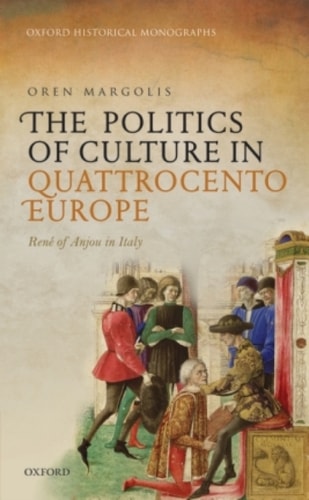
The Politics of Culture in Quattrocento Europe: René of Anjou in Italy
0
0
As an Amazon Associate and affiliate partner, Menrva Books earns from qualifying purchases. Learn more
Author Description
The poet-king without a throne appears here in an entirely new light. In The Politics of Culture in Quattrocento Europe: René of Anjou in Italy, Oren Margolis explores how this French prince and exiled king of Naples (1409-1480) engaged his Italian network in a programme of cultural politics conducted with an eye towards a return to power in the peninsula. Built on a series of original interpretations of humanistic and artistic material (chiefly Latin orations and illuminated manuscripts of classical texts), this is also a case study for a 'diplomatic approach' to culture. It recasts its source base as a form of high-level communication for a hyper-literate elite of those who could read the works created by humanist and artistic agents for their constituent parts: the potent words or phrases and relevant classical allusions; the channels through which a given work was commissioned or transmitted; and then the nature of the network gathered around a political agenda. This is a volume for all those interested in the politics and culture of later medieval Europe and Renaissance Italy: the kings of France and dukes of Burgundy, the Medici, the Sforza, the Venetians, and their armies, ambassadors, and adversaries all appear here; so do Giovanni Bellini, Andrea Mantegna, Guarino of Verona, and their respective intellectual and artistic circles. Emerging from it is a challenge to conventional interpretations of the politics of humanism, and a new vision of the Quattrocento: a century in which the Italian Renaissance began its takeover of Europe, but in which Renaissance culture was itself shaped by its European political, social, and diplomatic context.
Menrva's Summary
THE THESIS
This work investigates how René of Anjou utilized cultural production as a strategic instrument of diplomacy and political maneuvering to reclaim power in fifteenth-century Italy. Oren Margolis, a specialist in Renaissance history, examines the intersection of humanistic scholarship and political ambition through the lens of René’s patronage. By analyzing Latin orations and illuminated manuscripts, the author argues that these cultural artifacts functioned as sophisticated communication tools within a hyper-literate elite network, rather than mere aesthetic expressions.
THE SCOPE MAP
What You Will Find
- Analysis of the political and diplomatic networks surrounding René of Anjou in Quattrocento Italy.
- Examination of humanistic texts, Latin orations, and illuminated manuscripts as political instruments.
- Case studies involving prominent figures such as the Medici, the Sforza, Giovanni Bellini, and Andrea Mantegna.
Scope Limits
- The study focuses primarily on the diplomatic and political utility of culture rather than a comprehensive biography of René of Anjou.
- The analysis is restricted to the specific context of the Quattrocento period and its immediate European political environment.
THE AUTHORITY PERSPECTIVE
Scholars and historians recognize this monograph as a significant contribution to the study of Renaissance political culture and the mechanics of humanistic patronage. Readers frequently note the academic density of the prose, which is tailored for specialists in medieval and early modern European history.
Page Count:
240
Publication Date:
2016-01-01
Publisher:
OUP Oxford
ISBN-10:
0191082198
ISBN-13:
9780191082191
History
Renaissance
European History
Cultural History
History of the Americas
Political History
Art History
Community Tags
Similar Books