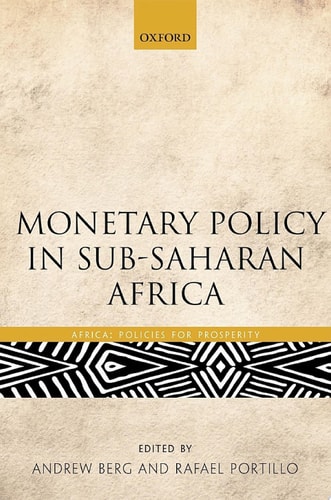
Monetary Policy in Sub-Saharan Africa
0
0
As an Amazon Associate and affiliate partner, Menrva Books earns from qualifying purchases. Learn more
Author Description
Low-income countries in sub-Saharan Africa present unique monetary policy challenges, from the high share of volatile food in consumption to underdeveloped financial markets; however most academic and policy work on monetary policy is aimed at much richer countries. Can economic models and methods invented for rich countries even be adapted and applied here? How does and should monetary policy work in sub-Saharan African? Monetary Policy in Sub-Saharan Africa answers these questions and provides practical tools and policy guidance to respond to the complex challenges of this region. Most countries in sub-Saharan Africa have made great progress in stabilizing inflation over the past two decades. As they have achieved a degree of basic macroeconomic stability, policymakers are looking to avoid policy misalignments and respond appropriately to shocks in order to achieve stability and growth. Officially, they often have adopted "money targeting" frameworks, a regime that has long disappeared from almost all advanced and even emerging-market discussions. In practice, though, they are in many cases finding current regimes lacking, with opaque and sometimes inconsistent objectives, inadequate transmission of policy to the economy, and difficulties in responding to supply shocks. Monetary Policy in Sub-Saharan Africa takes a new approach by applying dynamic general equilibrium models suitably adapted to reflect key features of low-income countries for the analysis of monetary policy in sub-Saharan African countries. Using a progressive approach derived from the International Monetary Fund's extensive practice and research, Monetary Policy in Sub-Saharan Africa seeks to address what we know about the empirics of monetary transmission in low-income countries, how monetary policy can work in countries characterized by underdeveloped financial markets and opaque policy regimes, and how we can use empirical and theoretical methods largely derived in advanced countries to answer
Menrva's Summary
THE THESIS
This work investigates whether economic models and methodologies developed for advanced economies can be effectively adapted to address the unique monetary policy challenges faced by low-income countries in sub-Saharan Africa. The authors, drawing on their expertise and research from the International Monetary Fund, evaluate the limitations of current money-targeting frameworks in the region. They propose a refined analytical approach using dynamic general equilibrium models tailored to the specific structural constraints of developing financial markets and volatile economic environments.
THE SCOPE MAP
What You Will Find
- Analysis of monetary transmission mechanisms in low-income economies.
- Application of dynamic general equilibrium models adapted for regional specificities.
- Practical policy guidance for managing inflation and responding to supply-side shocks.
Scope Limits
- The text does not provide a comprehensive history of all individual central bank policies in the region.
- It does not cover micro-level banking regulations or non-monetary fiscal policy interventions.
THE AUTHORITY PERSPECTIVE
Experts recognize this text as a significant contribution to the literature on development macroeconomics, specifically for its attempt to bridge the gap between advanced economic theory and the realities of emerging markets. Readers frequently note the technical density of the prose, which is intended for policy practitioners and academic researchers in the field of international finance.
Page Count:
473
Publication Date:
2018-01-01
Publisher:
OUP Oxford
ISBN-10:
0191088838
ISBN-13:
9780191088834
History
Economics
Macroeconomics
African history
Finance
Principles of Macroeconomics
Community Tags
Similar Books













Reader Comments
Share Your Thoughts
No comments yet. Be the first to share your thoughts!