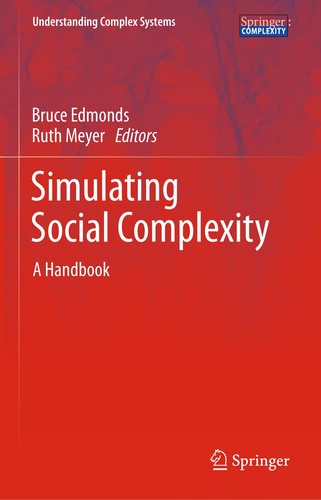
Simulating Social Complexity
0
0
As an Amazon Associate and affiliate partner, Menrva Books earns from qualifying purchases. Learn more
Author Description
Social systems are among the most complex known. This poses particular problems for those who wish to understand them. The complexity often makes analytic approaches infeasible and natural language approaches inadequate for relating intricate cause and effect. However, individual- and agent-based computational approaches hold out the possibility of new and deeper understanding of such systems. Simulating Social Complexity examines all aspects of using agent- or individual-based simulation. This approach represents systems as individual elements having each their own set of differing states and internal processes. The interactions between elements in the simulation represent interactions in the target systems. What makes these elements "social" is that they are usefully interpretable as interacting elements of an observed society. In this, the focus is on human society, but can be extended to include social animals or artificial agents where such work enhances our understanding of human society. The phenomena of interest then result (emerge) from the dynamics of the interaction of social actors in an essential way and are usually not easily simplifiable by, for example, considering only representative actors. The introduction of accessible agent-based modelling allows the representation of social complexity in a more natural and direct manner than previous techniques. In particular, it is no longer necessary to distort a model with the introduction of overly strong assumptions simply in order to obtain analytic tractability. This makes agent-based modelling relatively accessible to a range of scientists. The outcomes of such models can be displayed and animated in ways that also make them more interpretable by experts and stakeholders. This handbook is intended to help in the process of maturation of this new field. It brings together, through the collaborative effort of many leading researchers, summaries of the best thinking and practice in this area and consti
Menrva's Summary
THE THESIS
The challenge of understanding complex social systems is addressed through agent-based computational modeling. Bruce Edmonds, a leading researcher in the field, presents a comprehensive examination of agent- or individual-based simulation as a powerful tool for gaining new insights into social phenomena. This approach models systems as individual elements with distinct states and internal processes, where their interactions represent real-world social dynamics. The focus is primarily on human society but extends to social animals and artificial agents, with emergent phenomena arising from actor interactions rather than simplified representative models.
THE SCOPE MAP
- Explanation of agent-based modeling as a method for representing social complexity.
- Discussion of how agent-based modeling allows for more natural and direct representation compared to traditional analytic techniques.
- Emphasis on the ability to avoid overly strong assumptions for analytic tractability.
- Accessibility of agent-based modeling to a range of scientists.
- Demonstration of how model outcomes can be displayed and animated for interpretability by experts and stakeholders.
- Contribution to the maturation of agent-based modeling as a scientific field.
- Summaries of best thinking and practice from leading researchers in the area.
THE AUTHORITY PERSPECTIVE
This handbook is intended to advance the field of agent-based modeling for social complexity. By bringing together the work of leading researchers, it aims to provide a comprehensive overview of current best practices and thinking. The approach is presented as a more accessible and natural way to model social systems, allowing for deeper understanding by avoiding the need for overly simplifying assumptions. The visual and animated outputs of these models are highlighted as beneficial for interpretation by both scientific experts and broader stakeholders.
Page Count:
754
Publication Date:
2013-01-01
ISBN-10:
3540938133
ISBN-13:
9783540938132
Action
Non-Fiction
Philosophy
Science
Methodology
Computer Science
Social Science
Community Tags
Similar Books