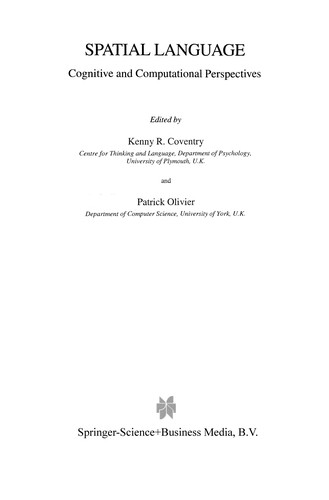
Spatial Language
0
0
As an Amazon Associate and affiliate partner, Menrva Books earns from qualifying purchases. Learn more
Author Description
People constantly talk to each other about experience or knowledge resulting from spatial perception; they describe the size, shape, orientation and position of objects using a wide range of spatial expressions. The semantic treatment of such expressions presents particular challenges for natural language processing. The meaning representation used must be capable of distinguishing between fine-grained sense differences and ambiguities grounded in our experience and perceptual structure. While there have been many different approaches to the representation and processing of spatial expressions, most computational characterisations have been restricted to particularly narrow problem domains. The chapters in the present volume reflect a commitment to the development of cognitively informed computational treatments of spatial language and spatial representation. Therefore the chapters present computational work, empirical work, or a combination of both. The book will appeal to all those interested in spatial language and spatial representation, whether they work in artificial intelligence, cognitive science, cognitive psychology or linguistics.
Menrva's Summary
THE THESIS
This volume investigates the complex relationship between spatial perception and the language used to describe it. The book addresses the challenges inherent in computationally processing spatial expressions, which require meaning representations capable of distinguishing subtle sense differences and ambiguities rooted in human experience and perceptual structures. It presents a collection of chapters that combine computational and empirical work, reflecting a commitment to developing cognitively informed approaches to spatial language and representation. The work is intended for researchers and practitioners in artificial intelligence, cognitive science, cognitive psychology, and linguistics.
THE SCOPE MAP
- Computational treatments of spatial language informed by cognitive science.
- Empirical studies on the perception and description of spatial information.
- Analysis of semantic representations for spatial expressions.
- Exploration of object size, shape, orientation, and position descriptions.
- Discussion of challenges in natural language processing for spatial language.
- Interdisciplinary perspectives from AI, cognitive science, psychology, and linguistics.
THE AUTHORITY PERSPECTIVE
The collection aims to bridge the gap between cognitive understanding and computational modeling of spatial language. By presenting a range of approaches, it seeks to advance the field's ability to process and represent spatial information accurately. The interdisciplinary nature of the contributions suggests a focus on theoretical frameworks and practical applications within artificial intelligence and cognitive science. The volume is positioned to appeal to a specialized audience interested in the intersection of language, perception, and computation.
Page Count:
283
Publication Date:
2002-01-01
ISBN-10:
9048159105
ISBN-13:
9789048159109
Non-Fiction
Psychology
Science
Philosophy
Art
Linguistics
Community Tags
Similar Books