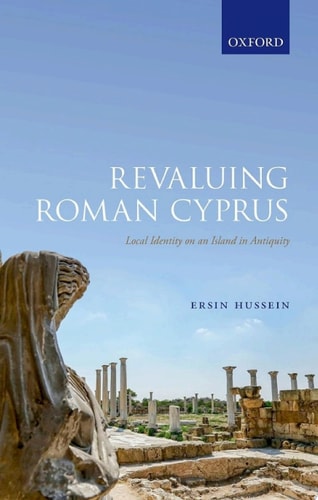
Revaluing Roman Cyprus: Local Identity on an Island in Antiquity
0
0
As an Amazon Associate and affiliate partner, Menrva Books earns from qualifying purchases. Learn more
Author Description
In Revaluing Roman Cyprus, Ersin Hussein provides a study of local identity formation in Roman Cyprus addresses its traditional characterisation as a weary, uneventful, and insignificant province and champions it as a rich case study for investigations of the Roman Empire. Hussein collates well-known, overlooked, and newly uncovered evidence to revaluate local responses to, and experiences of, Roman rule. The investigation opens with a look at the island as a real and imagined space to explore its marginalisation in ancient and modern scholarly narratives. Hussein revisits the events surrounding the annexation of the island by Rome from Ptolemaic Egypt and its subsequent administration to establish the dynamics between the inhabitants of the island and their rulers. The spread and impact of Roman citizenship across the island is assessed through an exploration of the strategies employed by individuals to distinguish themselves in local and regional contexts. Hussein examines the poleis of Roman Cyprus, notably the preservation of their myths in literary records and the production of these in the material record, are examined to explore collective identity formation. Roman Cyprus is revealed as an active and dynamic participant in negotiating its identity and status in the Roman Empire. An island was poised between multiple landscapes, Hussein shows how Cyprus maintained deep-rooted connections between mainland Greece, Egypt, Asia Minor, and the Near East.
Menrva's Summary
THE THESIS
This book investigates how Roman Cyprus functioned as an active, dynamic participant in the Roman Empire, challenging the traditional characterization of the province as insignificant or stagnant. Ersin Hussein, a scholar of Roman provincial history, synthesizes archaeological evidence, literary records, and administrative history to argue that Cypriot inhabitants actively negotiated their local identity within the broader imperial framework. By examining the island's unique position between Greece, Egypt, and the Near East, the author demonstrates how local populations utilized Roman citizenship and myth-making to maintain regional distinctiveness.
THE SCOPE MAP
What You Will Find
- Analysis of the transition from Ptolemaic Egypt to Roman administration.
- Examination of the role of Roman citizenship as a tool for social distinction.
- Investigation of the poleis and the preservation of local myths in material and literary records.
- Mapping of the island's geopolitical connections to mainland Greece, Asia Minor, and the Near East.
Scope Limits
- The study focuses primarily on the Roman period and does not provide an exhaustive history of Cyprus across all antiquity.
- The analysis is centered on identity formation and administrative dynamics rather than a comprehensive military or economic history of the island.
THE AUTHORITY PERSPECTIVE
Scholars and historians recognize this work as a significant contribution to the study of Roman provincial identity, particularly for its effort to move beyond traditional narratives of marginalization. Readers frequently note the academic rigor of the text, which serves as a valuable resource for those interested in the complexities of Roman administration and cultural integration in the Eastern Mediterranean.
Page Count:
192
Publication Date:
2021-01-01
Publisher:
OUP Oxford
ISBN-10:
0191083364
ISBN-13:
9780191083365
History
Ancient History
Mediterranean History
Archaeology
Roman Empire
Asia history
Community Tags
Similar Books