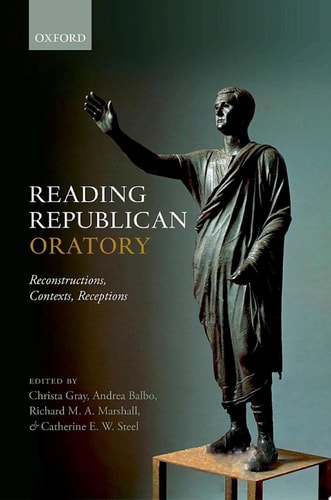
Reading Republican Oratory: Reconstructions, Contexts, Receptions
0
0
As an Amazon Associate and affiliate partner, Menrva Books earns from qualifying purchases. Learn more
Author Description
Public speech was a key aspect of politics in Republican Rome, both in theory and in practice, and recent decades have seen a surge in scholarly discussion of its significance and performance. Yet the partial nature of the surviving evidence means that our understanding of its workings is dominated by one man, whose texts are the only examples to have survived in complete form since antiquity: Cicero. This collection of essays aims to broaden our conception of the oratory of the Roman Republic by exploring how it was practiced by individuals other than Cicero, whether major statesmen, jobbing lawyers, or, exceptionally, the wives of politicians. It focuses particularly on the surviving fragments of such oratory, with individual essays tackling the challenges posed both by the partial and often unreliable nature of the evidence about these other Roman orators-often known to us chiefly through the tendentious observations of Cicero himself-and the complex intersections of the written fragments and the oral phenomenon. Collectively, the essays are concerned with the methods by which we are able to reconstruct non-Ciceronian oratory and the exploration of new ways of interpreting this evidence to tell us about the content, context, and delivery of those speeches. They are arranged into two thematic Parts, the first addressing questions of reception, selection, and transmission, and the second those of reconstruction, contextualization, and interpretation: together they represent a comprehensive overview of the non-Ciceronian speeches that will be of use to all ancient historians, philologists, and literary classicists with an interest in the oratory of the Roman Republic.
Menrva's Summary
THE THESIS
This collection of essays investigates how scholars can reconstruct and interpret the oratory of the Roman Republic beyond the dominant influence of Cicero. The editors, Andrea Balbo, Christa Gray, and Richard M. A. Marshall, assemble a series of scholarly contributions that address the methodological challenges of working with fragmentary evidence. By analyzing non-Ciceronian speakers, the volume seeks to provide a more nuanced understanding of the political and social functions of public speech in ancient Rome.
THE SCOPE MAP
What You Will Find
- Analysis of surviving fragments from non-Ciceronian Roman orators
- Methodologies for reconstructing oral performances from written texts
- Examination of the reception and transmission of Republican-era speeches
- Contextual studies of political figures, lawyers, and female orators
Scope Limits
- The volume does not provide a comprehensive history of Roman political institutions
- It does not offer a complete catalog of all known oratorical fragments
THE AUTHORITY PERSPECTIVE
Experts identify this collection as a significant contribution to the field of classical philology and Roman history. Readers frequently note the academic density of the prose, which is intended for specialists and advanced students of antiquity.
Page Count:
380
Publication Date:
2018-01-01
Publisher:
OUP Oxford
ISBN-10:
0191092312
ISBN-13:
9780191092312
History
Communications
Literary Criticism
English & College Success
Introduction to Human Communication
Ancient - Rome
Rhetoric
English
Community Tags
Similar Books