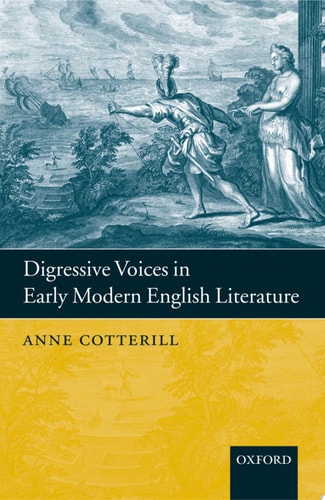
Digressive Voices in Early Modern English Literature
0
0
As an Amazon Associate and affiliate partner, Menrva Books earns from qualifying purchases. Learn more
Author Description
Digressive Voices in Early Modern English Literature looks afresh at major nondramatic texts by Donne, Marvell, Browne, Milton, and Dryden, whose digressive speakers are haunted by personal and public uncertainty. To digress in seventeenth-century England carried a range of meaning associated with deviation or departure from a course, subject, or standard. This book demonstrates that early modern writers trained in verbal contest developed richly labyrinthine voices that captured the ambiguities of political occasion and aristocratic patronage while anatomizing enemies and mourning personal loss. Anne Cotterill turns current sensitivity toward the silenced voice to argue that rhetorical amplitude might suggest anxieties about speech and attack for men forced to be competitive yet circumspect as they made their voices heard.
Menrva's Summary
THE THESIS
This work investigates how the rhetorical practice of digression in seventeenth-century English literature functioned as a strategic response to political instability and personal anxiety. Anne Cotterill, a scholar of early modern literature, examines major nondramatic texts by authors such as Donne, Marvell, Browne, Milton, and Dryden. She argues that these writers utilized digressive voices to navigate the complex pressures of aristocratic patronage and public discourse, transforming potential vulnerability into a sophisticated mode of expression.
THE SCOPE MAP
What You Will Find
- Analysis of major nondramatic works by Donne, Marvell, Browne, Milton, and Dryden
- Examination of the rhetorical concept of digression in the seventeenth century
- Exploration of the intersection between political patronage and literary voice
- Study of how rhetorical amplitude masks anxieties regarding speech and social standing
Scope Limits
- The analysis is restricted to nondramatic texts of the seventeenth century
- The study does not focus on dramatic works or theatrical performance
THE AUTHORITY PERSPECTIVE
Scholars recognize this text as a significant contribution to the study of early modern rhetoric and the sociopolitical context of seventeenth-century authorship. Readers frequently note the academic density of the prose and the depth of the author's engagement with historical literary theory.
Page Count:
352
Publication Date:
2004-01-01
Publisher:
Oxford University Press
ISBN-10:
0191532061
ISBN-13:
9780191532061
History
Rhetoric
English literature
Literary Criticism
English
Nonfiction
English & College Success
Seventeenth Century