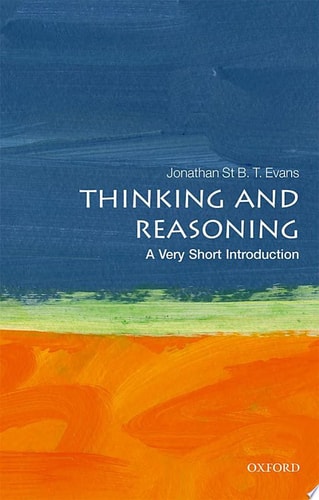
Thinking and Reasoning: A Very Short Introduction
0
0
As an Amazon Associate and affiliate partner, Menrva Books earns from qualifying purchases. Learn more
Author Description
Our Extraordinary Capacity To Reason And Solve Problems Sets Us Aside From Other Animals, But Our Evolved Thinking Processes Also Leave Us Susceptibile To Bias And Error. The Study Of Thinking And Reasoning Goes Back To Aristotle, And Was One Of The First Topics To Be Studied When Psychology Separated From Philosophy. In This Very Short Introduction Jonathan Evans Explores Cognitive Psychological Approaches To Understanding The Nature Of Thinking And Reasoning, Problem Solving, And Decision Making. He Shows How Our Problem Solving Capabilities Are Hugely Dependent On Also Having The Imagination To Ask The Right Questions, And The Ability To See Things From A Completely New Perspective. Beginning By Considering The Approaches Of The Behaviourists And The Gestalt Psychologists, He Moves On To Modern Explorations Of Thinking, Including Hypothetical Thinking, Conditionals, Deduction, Rationality, And Intuition. Covering The Role Of Past Learning, Iq, And Cognitive Biases, Evans Also Discusses The Idea That There May Be Two Different Ways Of Thinking, Arising From Our Evolutionary History. About The Series: The Very Short Introductions Series From Oxford University Press Contains Hundreds Of Titles In Almost Every Subject Area. These Pocket-sized Books Are The Perfect Way To Get Ahead In A New Subject Quickly. Our Expert Authors Combine Facts, Analysis, Perspective, New Ideas, And Enthusiasm To Make Interesting And Challenging Topics Highly Readable.
Menrva's Summary
THE THESIS
How do human cognitive processes facilitate complex problem-solving while simultaneously predisposing individuals to systematic bias and error? Jonathan St. B. T. Evans, a prominent researcher in the psychology of reasoning, utilizes established cognitive psychological frameworks to examine the mechanisms of human thought. The text synthesizes historical perspectives from behaviorism and Gestalt psychology with contemporary findings on intuition, rationality, and dual-process theory to explain the architecture of the human mind.
THE SCOPE MAP
What You Will Find
- Historical overview of psychological approaches to reasoning from Aristotle to modern cognitive science.
- Analysis of dual-process theory regarding evolutionary thinking patterns.
- Examination of cognitive biases, IQ, and the role of past learning in decision-making.
- Exploration of hypothetical thinking, deduction, and conditional logic.
Scope Limits
- The text does not provide an exhaustive clinical manual for overcoming specific cognitive biases.
- It does not focus on neurobiological mapping or brain imaging studies.
THE AUTHORITY PERSPECTIVE
Experts and readers recognize this work as a concise, accessible entry point into the field of cognitive psychology. The prose is noted for its clarity and ability to distill complex theoretical frameworks into a format suitable for students and general readers alike.
Page Count:
144
Publication Date:
2017-01-01
Publisher:
Oxford University Press
ISBN-10:
019109112X
ISBN-13:
9780191091124
Psychology
Philosophy
Non-Fiction
Education