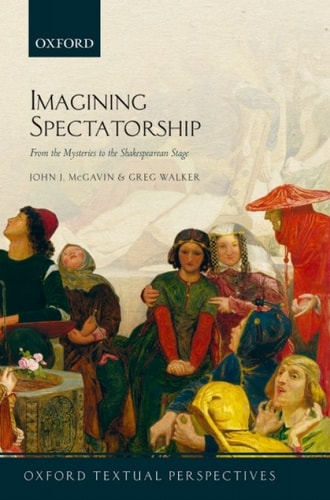
Imagining Spectatorship: From the Mysteries to the Shakespearean Stage
0
0
As an Amazon Associate and affiliate partner, Menrva Books earns from qualifying purchases. Learn more
Author Description
Oxford Textual Perspectives is a new series of informative and provocative studies focused upon literary texts (conceived of in the broadest sense of that term) and the technologies, cultures and communities that produce, inform, and receive them. It provides fresh interpretations of fundamental works and of the vital and challenging issues emerging in English literary studies. By engaging with the materiality of the literary text, its production, and reception history, and frequently testing and exploring the boundaries of the notion of text itself, the volumes in the series question familiar frameworks and provide innovative interpretations of both canonical and less well-known works. Imagining Spectatorship offers a new discussion of how spectators witnessed early drama in the various spaces and places in which those works were performed. It combines broad historical and theoretical reflection with closely analysed case studies to produce a comprehensive account of the ways in which individuals encountered early drama, how they were cued to respond to it, and how we might think about those issues today. It addresses the practical matters that conditioned spectatorship, principally those concerned with the location and configuration of the spaces in which a performance occurred, but also suggests how these factors intersected with social status, gender, religious commitment and affiliation, degrees of real or felt personal agency, and the operation of the cognitive processes themselves. It considers both real witnesses and those 'imagined' spectators which are seemingly figured by both dramatic and quasi-dramatic works, and whose assumed attitudes play-makers sought to second-guess. It also looks at the spectatorial experience itself as a subject of representation in a number of early texts. Finally, it examines the complex contract entered into by audiences and players for the duration of a performance, looking at how texts cued spectators to respond to specific
Menrva's Summary
THE THESIS
How did the physical and social environments of early drama shape the cognitive and emotional responses of the audience? John J. McGavin and Greg Walker investigate the historical and theoretical dimensions of spectatorship from the medieval mystery plays through the Elizabethan stage. By synthesizing archival research with performance theory, the authors argue that the act of witnessing was a complex negotiation between the spatial configuration of the performance site and the social identity of the individual viewer.
THE SCOPE MAP
What You Will Find
- Analysis of performance spaces ranging from medieval mystery cycles to Shakespearean playhouses.
- Examination of the 'imagined spectator' as a construct within dramatic texts.
- Discussion of how social status, gender, and religious affiliation influenced audience reception.
- Theoretical frameworks for understanding the cognitive processes of early modern theatergoers.
Scope Limits
- The study focuses primarily on English drama and does not provide a global history of theater.
- It does not offer a comprehensive survey of every play from the period, but rather utilizes specific case studies to illustrate broader spectatorial dynamics.
THE AUTHORITY PERSPECTIVE
Scholars in the field of early modern studies recognize this work as a significant contribution to the understanding of performance reception and audience dynamics. Readers frequently note the academic density of the prose and the authors' rigorous application of historical context to theoretical questions of spectatorship.
Page Count:
228
Publication Date:
2016-01-01
Publisher:
OUP Oxford
ISBN-10:
0191081620
ISBN-13:
9780191081620
English & College Success
Literary Criticism
Cultural History
Theater History
Early Modern
Performance Studies
English
Community Tags
Other Editions(2)

Similar Books












Reader Comments
Share Your Thoughts
No comments yet. Be the first to share your thoughts!