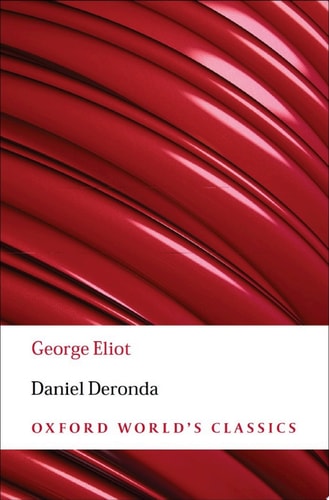
Daniel Deronda
0
0
As an Amazon Associate and affiliate partner, Menrva Books earns from qualifying purchases. Learn more
Author Description
'she felt herself standing at the game of life with many eyes upon her, daring everything to win much' Gwendolen Harleth gambles her happiness when she marries a sadistic aristocrat for his money. Beautiful, neurotic, and self-centred, Gwendolen is trapped in an increasingly destructive relationship, and only her chance encounter with the idealistic Deronda seems to offer the hope of a brighter future. Deronda is searching for a vocation, and in embracing the Jewish cause he finds one that is both visionary and life-changing. Damaged by their pasts, and alienated from the society around them, they must both discover the values that will give their lives meaning. George Eliot's powerful novel is set in a Britain whose ruling class is decadent and materialistic, its power likely to be threatened by a politically emergent Germany. The novel's exploration of sexuality, guilt, and the will to power anticipates later developments in fiction, and its linking of the personal and the political in a context of social and economic crisis gives it especial relevance to the dominant issues of the twenty-first century.
Menrva's Summary
THE PULSE
Gwendolen Harleth enters a volatile marriage with a sadistic aristocrat, setting in motion a struggle for personal autonomy and moral clarity. The narrative follows Gwendolen, a self-centered woman seeking status, and Daniel Deronda, a man searching for his true heritage and purpose. As Gwendolen faces the consequences of her choices within a rigid, materialistic society, Deronda navigates his own path toward a visionary vocation. The novel utilizes a dual-narrative structure to contrast the internal growth of its protagonists against the backdrop of a changing British social order.
INSIDE THE PAGES
- Dual-protagonist narrative structure
- Exploration of Victorian social and economic crises
- Examination of Jewish identity and Zionism
- Psychological depth in character development
- Critique of aristocratic materialism
- Themes of guilt and the will to power
- Interweaving of personal morality and political duty
- Detailed depiction of nineteenth-century British class dynamics
THE COLLECTIVE ECHO
Readers and critics frequently highlight the novel's ambitious scope in balancing personal character arcs with broader social commentary. Discussion often centers on the stark contrast between Gwendolen's psychological turmoil and Deronda's idealistic pursuit of his heritage. Many observers note that the prose maintains a high level of intellectual rigor, which requires patience from the reader. The effectiveness of the world-building is often praised for its sharp critique of the decadence prevalent in the ruling class of the era. Ultimately, the work is recognized for its foresight in addressing themes that remain relevant to contemporary social and political discourse.
Page Count:
769
Publication Date:
2014-01-01
Publisher:
OUP Oxford
ISBN-10:
0191505374
ISBN-13:
9780191505379
Romance
England
classic
Social Realism
English
Historical
Victorian
Philosophical
English & College Success
Jews
Community Tags
Other Editions(22)
Independently published
2024
Default edition
Independently published
2020
Independently published
2020

Blackstone Audiobooks
2014
Oup Oxford
2014
OUP Oxford
2014

Nabu Press
2011

BiblioLife
2009

BiblioBazaar
2009

BiblioLife
2009

BiblioLife
2009

BiblioBazaar
2009

BiblioBazaar
2009

BiblioLife
2009

BiblioBazaar
2009

BiblioBazaar
2009

BiblioLife
2009

BiblioLife
2009

BiblioLife
2009

BBC Audiobooks
2001

Oxford University Press
1988
Oxford University Press
1985
Similar Books

Reader Comments
Share Your Thoughts
No comments yet. Be the first to share your thoughts!