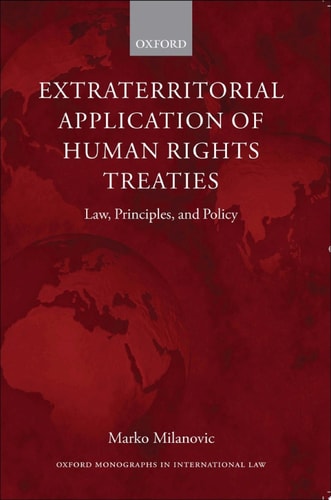
Extraterritorial Application of Human Rights Treaties: Law, Principles, and Policy
0
0
As an Amazon Associate and affiliate partner, Menrva Books earns from qualifying purchases. Learn more
Author Description
Questions as to when a state owes obligations under a human rights treaty towards an individual located outside its territory are being brought more and more frequently before both international and domestic courts. Victims of aerial bombardment, inhabitants of territories under military occupation, deposed dictators, suspected terrorists detained in Guantanamo by the United States, and the family of a former KGB spy who was assassinated in London through the use of a radioactive toxin, allegedly at the orders or with the collusion of the Russian government - all of these people have claimed protection from human rights law against a state affecting their lives while acting outside its territory. These matters are extremely politically and legally sensitive, leading to much confusion, ambiguity and compromise in the existing case law. This study attempts to clear up some of this confusion, and expose its real roots. It examines the notion of state jurisdiction in human rights treaties, and places it within the framework of international law. It is not limited to an inquiry into the semantic, ordinary meaning of the jurisdiction clauses in human rights treaties, nor even to their construction into workable legal concepts and rules. Rather, the interpretation of these treaties cannot be complete without examining their object and purpose, and the various policy considerations which influence states in their behaviour, and courts in their decision-making. The book thus exposes the tension between universality and effectiveness, which is itself the cause of methodological and conceptual inconsistency in the case law. Finally, the work elaborates on the several possible models of the treaties' extraterritorial application. It offers not only a critical analysis of the existing case law, but explains the various options that are before courts and states in addressing these issues, as well as their policy implications.
Menrva's Summary
THE THESIS
This book investigates the legal and policy framework governing the extraterritorial application of human rights treaties, specifically addressing the confusion surrounding when a state owes obligations to individuals outside its territory. Marko Milanovic, a scholar of international law, utilizes a comprehensive analysis of international case law and treaty interpretation to argue that the inconsistency in current rulings stems from an unresolved tension between the universality of human rights and the practical effectiveness of state jurisdiction. The work provides a structured examination of how policy considerations influence judicial decision-making and state behavior in sensitive geopolitical contexts.
THE SCOPE MAP
What You Will Find
- Analysis of state jurisdiction within international human rights treaties
- Examination of the tension between universality and effectiveness in legal interpretation
- Evaluation of multiple models for extraterritorial treaty application
- Review of high-profile cases involving military occupation, detention, and state-sponsored actions
Scope Limits
- Does not provide a definitive legislative solution for all future international conflicts
- Focuses primarily on treaty-based human rights law rather than customary international law in isolation
THE AUTHORITY PERSPECTIVE
Legal scholars and practitioners frequently cite this work as a definitive text for navigating the complexities of extraterritorial jurisdiction. Experts highlight the academic rigor of the analysis, noting that it serves as a foundational resource for understanding the methodological inconsistencies present in international court rulings.
Page Count:
302
Publication Date:
2013-01-01
Publisher:
OUP Oxford
ISBN-10:
0191504807
ISBN-13:
9780191504808
Treaties
Human rights
International Law
Professional Career & Trade
LAW Public
Legal Theory
Community Tags
Other Editions(2)
Similar Books















Reader Comments
Share Your Thoughts
No comments yet. Be the first to share your thoughts!