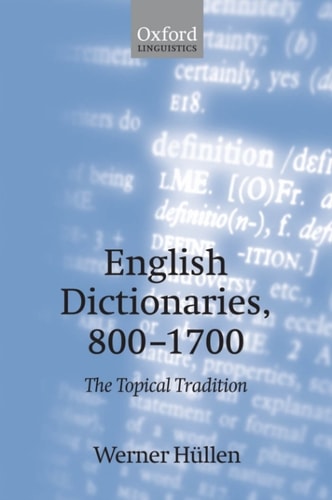
English Dictionaries, 800-1700: The Topical Tradition
0
0
As an Amazon Associate and affiliate partner, Menrva Books earns from qualifying purchases. Learn more
Author Description
Between the beginnings of European lexicography and 1700, many glossaries and dictionaries were arranged not according to the alphabet, but in a topical order which followed the influential paradigms of theology, philosophy, and natural history at that time. Together with related text genres like treatises on terminology, didactic dialogues, and thesauri, they constitute the topical (or onomasiological) tradition which is an important lexicographical tradition in its own right. This book discusses the tradition's principles and origins, and by way of illustration draws upon early glossaries, treatises for the learning of foreign languages, and didactic dialogues. Later comprehensive works are presented as detailed in-depth studies. Professor Hüllen demonstrates that the English tradition is embedded in a complex Continental tradition whose important representatives, such as Adrianus Junius and Comenius, had a great influence on the English scene.
Menrva's Summary
THE THESIS
This work investigates the historical development and structural principles of the topical, or onomasiological, tradition in English lexicography between 800 and 1700. Werner Hüllen, a scholar of English linguistics, utilizes a comparative historical framework to analyze how early dictionaries were organized by subject matter rather than alphabetical order. He situates these English texts within a broader Continental European context, demonstrating how theological, philosophical, and natural history paradigms shaped the evolution of language reference materials.
THE SCOPE MAP
What You Will Find
- Analysis of non-alphabetical dictionary structures
- Examination of related genres including didactic dialogues and thesauri
- In-depth studies of comprehensive works from the 17th century
- Comparative analysis of English and Continental European lexicographical influences
Scope Limits
- The study is restricted to the period between 800 and 1700
- The focus remains primarily on topical organization rather than the development of alphabetical lexicography
THE AUTHORITY PERSPECTIVE
Scholars recognize this text as a foundational resource for understanding the pre-alphabetical history of English dictionaries. The prose is noted for its academic density and rigorous attention to the philosophical underpinnings of early lexicographical traditions.
Page Count:
544
Publication Date:
2006-01-01
Publisher:
OUP Oxford
ISBN-10:
019151618X
ISBN-13:
9780191516184
English
Language History
Linguistics
Lexicography
Academic
English & College Success
Reference
Community Tags
Similar Books