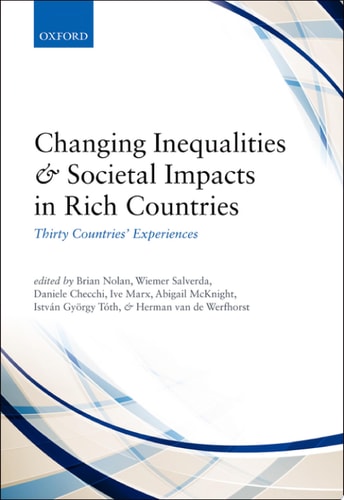
Changing Inequalities and Societal Impacts in Rich Countries: Thirty Countries' Experiences
0
0
As an Amazon Associate and affiliate partner, Menrva Books earns from qualifying purchases. Learn more
Author Description
There has been a remarkable upsurge of debate about increasing inequalities and their societal implications, reinforced by the economic crisis but bubbling to the surface before it. This has been seen in popular discourse, media coverage, political debate, and research in the social sciences. The central questions addressed by this book, and the major research project GINI on which it is based, are: - Have inequalities in income, wealth and education increased over the past 30 years or so across the rich countries, and if so why? - What are the social, cultural and political impacts of increasing inequalities in income, wealth and education? - What are the implications for policy and for the future development of welfare states? In seeking to answer these questions, this book adopts an interdisciplinary approach that draws on economics, sociology, and political science, and applies a common analytical framework to the experience of 30 advanced countries, namely all the EU member states except Cyprus and Malta, together with the USA, Japan, Canada, Australia and South Korea. It presents a description and analysis of the experience of each of these countries over the past three decades, together with an introduction, an overview of inequality trends, and a concluding chapter highlighting key findings and implications. These case-studies bring out the variety of country experiences and the importance of framing inequality trends in the institutional and policy context of each country if one is to adequately capture and understand the evolution of inequality and its impacts.
Menrva's Summary
THE THESIS
This book investigates whether income, wealth, and educational inequalities have increased across thirty advanced nations over the past three decades and examines the subsequent social, cultural, and political consequences. The authors, Abigail McKnight, Brian Nolan, and Daniele Checchi, utilize data from the GINI research project to provide a comprehensive, interdisciplinary analysis. By applying a unified analytical framework to diverse national contexts, the text evaluates how institutional and policy variations influence the trajectory of inequality and the future of welfare states.
THE SCOPE MAP
What You Will Find
- Longitudinal data on income, wealth, and education trends spanning thirty years.
- Comparative analysis of EU member states, the USA, Japan, Canada, Australia, and South Korea.
- An interdisciplinary framework integrating economic, sociological, and political science perspectives.
Scope Limits
- The study excludes Cyprus and Malta from the EU member state analysis.
- The research focuses primarily on advanced, high-income economies rather than developing nations.
THE AUTHORITY PERSPECTIVE
Experts recognize this work as a foundational comparative study for understanding the institutional drivers of inequality in developed nations. Readers frequently note the academic density of the prose, which serves as a primary resource for researchers and policymakers interested in the GINI project findings.
Page Count:
784
Publication Date:
2014-01-01
Publisher:
OUP Oxford
ISBN-10:
0191511102
ISBN-13:
9780191511103
Economics
Inequality
Public Policy
DemographyPopulation
Sociology
Principles of Macroeconomics
Social policy
Community Tags
Similar Books