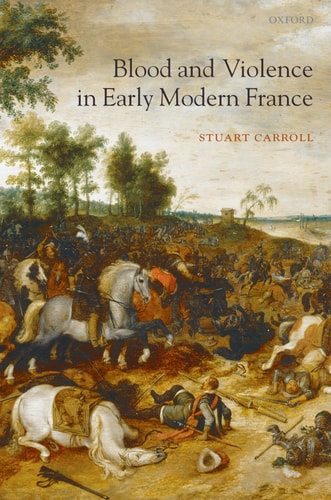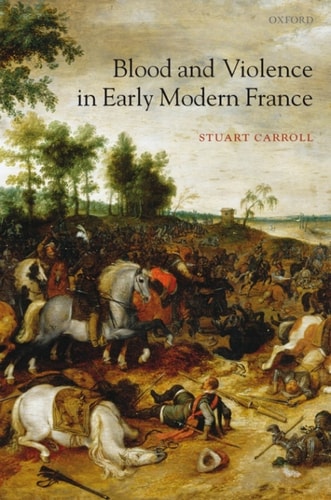
Blood and Violence in Early Modern France
0
0
As an Amazon Associate and affiliate partner, Menrva Books earns from qualifying purchases. Learn more
Author Description
The rise of civilized conduct and behaviour has long been seen as one of the major factors in the transformation from medieval to modern society. Thinkers and historians alike argue that violence progressively declined as men learned to control their emotions. The feud is a phenomenon associated with backward societies, and in the West duelling codified behaviour and channelled aggression into ritualised combats that satisfied honour without the shedding of blood. French manners and codes of civility laid the foundations of civilized Western values. But as this original work of archival research shows we continue to romanticize violence in the era of the swashbuckling swordsman. In France, thousands of men died in duels in which the rules of the game were regularly flouted. Many duels were in fact mini-battles and must be seen not as a replacement of the blood feud, but as a continuation of vengeance-taking in a much bloodier form. This book outlines the nature of feuding in France and its intensification in the wake of the Protestant Reformation, civil war and dynastic weakness, and considers the solutions proposed by thinkers from Montaigne to Hobbes. The creation of the largest standing army in Europe since the Romans was one such solution, but the militarization of society, a model adopted throughout Europe, reveals the darker side of the civilizing process.
Menrva's Summary
THE THESIS
This work investigates the historical reality of violence in early modern France, challenging the traditional narrative that the period was defined by a steady decline in aggression and the rise of civilized conduct. Stuart Carroll, a historian specializing in early modern Europe, utilizes extensive archival research to argue that the era was characterized by persistent feuding and lethal dueling rather than a transition toward peaceful social norms. He posits that the state's response to this violence—specifically the creation of large standing armies—led to the militarization of society, which paradoxically reinforced rather than eliminated violent behaviors.
THE SCOPE MAP
What You Will Find
- Analysis of the intensification of feuding following the Protestant Reformation and civil wars.
- Examination of the discrepancy between the idealized 'swashbuckling' image of the duelist and the lethal reality of early modern combat.
- Evaluation of political and philosophical responses to violence from thinkers including Montaigne and Hobbes.
Scope Limits
- The study focuses primarily on the French context and does not provide a comprehensive comparative analysis of all European nations.
- The book does not attempt to cover the entirety of the early modern period, focusing instead on the specific dynamics of the 16th and 17th centuries.
THE AUTHORITY PERSPECTIVE
Historians and scholars of early modern Europe frequently cite this work for its rigorous archival foundation and its critical stance on the 'civilizing process' theory. Experts highlight the text as a significant contribution to the study of social violence, noting that it provides a necessary corrective to romanticized views of the period.
Page Count:
384
Publication Date:
2006-01-01
Publisher:
OUP Oxford
ISBN-10:
0191516147
ISBN-13:
9780191516146
History
Violence
Early Modern
French History
European History
Social History