Mood and Mobility
0
0
As an Amazon Associate and affiliate partner, Menrva Books earns from qualifying purchases. Learn more
Author Description
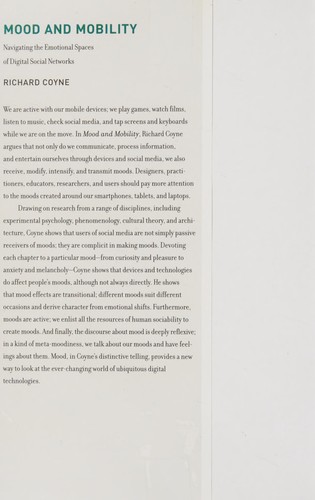
We are active with our mobile devices; we play games, watch films, listen to music, check social media, and tap screens and keyboards while we are on the move. In Mood and Mobility, Richard Coyne argues that not only do we communicate, process information, and entertain ourselves through devices and social media; we also receive, modify, intensify, and transmit moods. Designers, practitioners, educators, researchers, and users should pay more attention to the moods created around our smartphones, tablets, and laptops. -- Provided by publisher. Drawng on research from a range of disciplines, including experimental psychology, phenomenology, cultural theory, and architecture, Coyne shows that users of social media are not simply passive receivers of moods; they are complicit in making moods. Devoting each chapter to a particular moodfrom curiosity and pleasure to anxiety and melancholyCoyne shows that devices and technologies do affect peoples moods, although not always directly. He shows that mood effects are transitional; different moods suit different occasions, and derive character from emotional shifts. Furthermore, moods are active; we enlist all the resources of human sociability to create moods. And finally, the discourse about mood is deeply reflexive; in a kind of meta-moodiness, we talk about our moods and have feelings about them. Mood, in Coynes distinctive telling, provides a new way to look at the ever-changing world of ubiquitous digital technologies. -- Provided by publisher.
Menrva's Summary
THE THESIS
Digital technologies are not merely tools for communication and information processing, but active agents in the creation and modification of human moods. Richard Coyne, drawing on psychology, phenomenology, cultural theory, and architecture, argues that users are complicit in generating moods through their engagement with smartphones, tablets, and laptops. The book explores specific moods, such as curiosity, pleasure, anxiety, and melancholy, demonstrating how transitional and occasion-dependent emotional shifts are shaped by ubiquitous digital technologies. Coyne posits that moods are active, enlisted through human sociability, and that our discourse about moods is inherently reflexive, creating a meta-moodiness around our digital experiences.
THE SCOPE MAP
- Exploration of how mobile devices and social media influence and transmit moods.
- Analysis of user complicity in mood creation through digital engagement.
- Examination of specific moods including curiosity, pleasure, anxiety, and melancholy.
- Discussion of the transitional and occasion-dependent nature of mood effects.
- Investigation into the active role of human sociability in shaping moods.
- Analysis of the reflexive nature of discourse surrounding moods and digital technology.
- Integration of research from experimental psychology, phenomenology, cultural theory, and architecture.
THE AUTHORITY PERSPECTIVE
In 'Mood and Mobility,' Richard Coyne presents a compelling argument that our digital devices actively shape our emotional states, moving beyond simple communication tools to become mood-modifying agents. The book is lauded for its interdisciplinary approach, synthesizing insights from psychology, phenomenology, and cultural theory to explore how users are not just passive recipients but active participants in creating moods. Coyne's detailed examination of various moods, from curiosity to melancholy, offers a nuanced perspective on the transitional and socially constructed nature of our emotional experiences in the digital age. The work is recognized for providing a novel framework for understanding the complex interplay between ubiquitous technologies and human affect.
Page Count:
378
Publication Date:
2016-01-01
ISBN-10:
0262029758
ISBN-13:
9780262029759
Action
Philosophy
Psychology
Non-Fiction
Sociology
Cultural Theory
Technology
Community Tags
Similar Books