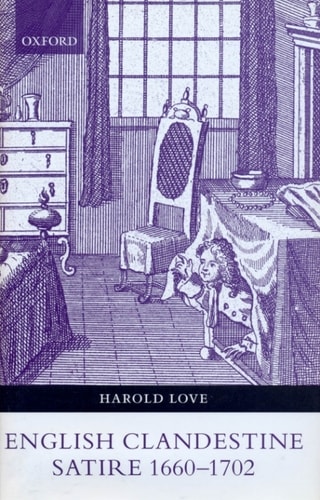
English Clandestine Satire, 1660-1702
0
0
As an Amazon Associate and affiliate partner, Menrva Books earns from qualifying purchases. Learn more
Author Description
In early modern Britain, the primary medium of free comment was the clandestine satire, circulated either orally or in manuscript. Part of the national political culture from Jacobean times, satire reached its greatest influence following the Restoration of Charles II, when a new 'easy' style, combining courtly polish with demotic frankness and flagrant indecency, led to the composition of thousands of such poems. Most of the poets of the time, including such major talents as Marvell and Rochester, wrote in the genre, though nearly always anonymously. While its chief targets were political, much Restoration satire concerned itself with the emerging demography of 'Town' and its uncertain experimentation with new kinds of social freedom. Attacks on the sexual misbehaviour (real or imagined) of aristocratic women hover, equally uncertainly, between moral condemnation and ill-disguised envy, while also conferring an inverse celebrity status on their victims. In this paradoxical social world, not to be lampooned could mean that one was no longer a person of importance. In the first comprehensive survey of this vast field, Harold Love considers the relationship of the lampoon to gossip, how one might construct a poetics of the genre, and how clandestine satire reached and was received by its readers. Constructing three primary categories of 'court', 'Town' and 'state' lampooning, Love argues that far from being the product of isolated disaffection, most satire was the work of a circle of recognized poets, frequently operating in collaboration. An extensive first-line index to the principal manuscript sources for clandestine satire makes this book an open sesame to further exploration of its fascinating field.
Menrva's Summary
THE THESIS
This work investigates the function and cultural significance of clandestine satire as a primary medium for political and social commentary in Britain between 1660 and 1702. Harold Love, a scholar of early modern literature, utilizes an extensive analysis of manuscript sources and political history to argue that these anonymous lampoons were not the work of isolated individuals, but rather the product of collaborative circles of poets. He establishes a framework that categorizes these works into court, Town, and state lampooning to explain their role in the national political culture of the Restoration era.
THE SCOPE MAP
What You Will Find
- A comprehensive survey of Restoration-era manuscript poetry and clandestine satire.
- A structural framework categorizing satire into court, Town, and state lampooning.
- An extensive first-line index of principal manuscript sources for further research.
- Analysis of the relationship between lampooning, gossip, and social status.
Scope Limits
- The study is strictly limited to the period between 1660 and 1702.
- The analysis focuses primarily on British political and social contexts rather than continental European satire.
THE AUTHORITY PERSPECTIVE
Scholars and historians recognize this text as a foundational resource for understanding the manuscript culture and political discourse of the late seventeenth century. Readers frequently note the academic density of the prose and the utility of the provided index for specialized research into Restoration poetry.
Page Count:
442
Publication Date:
2004-01-01
Publisher:
Oxford University Press
ISBN-10:
0191514500
ISBN-13:
9780191514500
History
Poetry
British History
English & College Success
English
Restoration Literature
Political History
Literary Criticism
Community Tags
Other Editions(3)

Similar Books


Reader Comments
Share Your Thoughts
No comments yet. Be the first to share your thoughts!