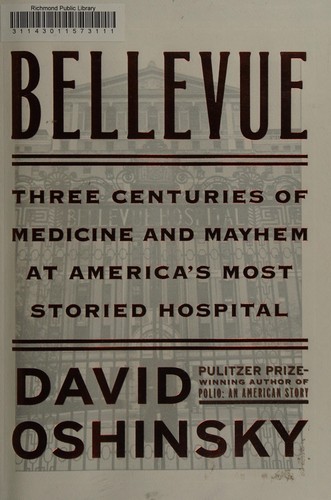
Bellevue
0
0
As an Amazon Associate and affiliate partner, Menrva Books earns from qualifying purchases. Learn more
Author Description
A history of the iconic public hospital on New York City's East Side describes the changes in American medicine from 1730 to modern times as it traces the building's origins as an almshouse and pesthouse to its current status as a revered place of first-class care. Bellevue Hospital, on New York City's East Side, occupies a colorful and horrifying place in the public imagination: a den of mangled crime victims, vicious psychopaths, assorted derelicts, lunatics, and exotic-disease sufferers. In its two and a half centuries of service, there was hardly an epidemic or social catastrophe--or groundbreaking scientific advance--that did not touch Bellevue. David Oshinsky, whose last book, Polio: An American Story, was awarded a Pulitzer Prize, chronicles the history of America's oldest hospital and in so doing also charts the rise of New York to the nation's preeminent city, the path of American medicine from butchery and quackery to a professional and scientific endeavor, and the growth of a civic institution. From its origins in 1738 as an almshouse and pesthouse, Bellevue today is a revered public hospital bringing first-class care to anyone in need. With its diverse, ailing, and unprotesting patient population, the hospital was a natural laboratory for the nation's first clinical research. It treated tens of thousands of Civil War soldiers, launched the first civilian ambulance corps and the first nursing school for women, pioneered medical photography and psychiatric treatment, and spurred New York City to establish the country's first official Board of Health. As medical technology advanced, "voluntary" hospitals began to seek out patients willing to pay for their care. For charity cases, it was left to Bellevue to fill the void. The latter decades of the twentieth century brought rampant crime, drug addiction, and homelessness to the nation's struggling cities--problems that called a public hospital's very survival into question. It took the AIDS crisis to cement
Menrva's Summary
THE THESIS
Bellevue Hospital's history mirrors the evolution of American medicine and New York City's rise. This book chronicles the transformation of Bellevue Hospital from its 1738 origins as an almshouse and pesthouse to its current status as a revered public hospital providing first-class care. The narrative traces the hospital's role in major epidemics, social catastrophes, and scientific advances, serving as a natural laboratory for clinical research and pioneering numerous medical firsts. It also reflects the broader shifts in American medicine from rudimentary practices to a professional, scientific endeavor, and the changing landscape of urban healthcare as voluntary hospitals emerged.
THE SCOPE MAP
- The origins of Bellevue as an almshouse and pesthouse in 1738.
- Bellevue's role in treating Civil War soldiers and pioneering the first civilian ambulance corps.
- The establishment of the first nursing school for women and advancements in medical photography and psychiatric treatment.
- The impact of the AIDS crisis on public hospitals.
- The evolution of American medicine from early practices to scientific advancements.
- The growth of New York City as a major urban center and the development of public health institutions.
THE AUTHORITY PERSPECTIVE
David M. Oshinsky's "Bellevue" is recognized for its comprehensive historical account of one of America's most iconic public hospitals. The book is praised for its detailed exploration of the hospital's role in shaping medical history and urban development, drawing on its extensive two-and-a-half-century legacy. Readers and critics alike have noted Oshinsky's ability to weave together the personal stories of patients and medical professionals with the broader societal and scientific changes that occurred within its walls. The work is seen as a significant contribution to the understanding of public healthcare in America.
Page Count:
387
Publication Date:
2016-01-01
ISBN-10:
038552336X
ISBN-13:
9780385523363
Science
Non-Fiction
History
Biography
Health
MEDICAL History
Community Tags
Similar Books