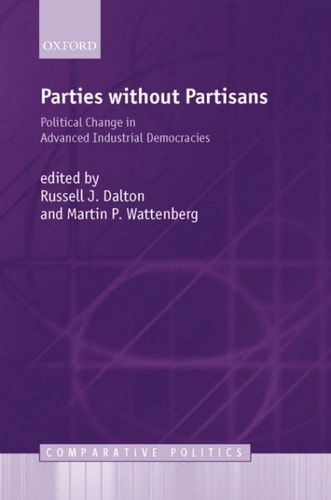
Parties without Partisans: Political Change in Advanced Industrial Democracies
0
0
As an Amazon Associate and affiliate partner, Menrva Books earns from qualifying purchases. Learn more
Author Description
If democracy without political parties is unthinkable, what would happen if the role of political parties if the democratic process is weakened? The ongoing debate about the vitality of political parties is also a debate about the vitality of representative democracy. Leading scholars in the field of party research assess the evidence for partisan decline or adaptation for the OECD nations in this book. It documents the broadscale erosion of the public's partisan identities in virtually all advanced industrial democracies. Partisan dealignment is diminishing involvement in electoral politics, and for those who participate it leads to more volatility in their voting choices, an openness to new political appeals, and less predictablity in their party preferences. Political parties have adapted to partisan dealignment by strengthening their internal organizational structures and partially isolating themselves from the ebbs and flows of electoral politics. Centralized, professionalized parties with short time horizons have replaced the ideologically-driven mass parties of the past. This study also examines the role of parties within government, and finds that parties have retained their traditional roles in structuring legislative action and the function of government-further evidence that party organizations are insulating themselves from the changes transforming democratic publics. Parties without Partisans is the most comprehensive cross-national study of parties in advanced industrial democracies in all of their forms -- in electoral politics, as organizations, and in government. Its findings chart both how representative democracy has been transformed in the later half of the 20th Century, as well as what the new style of democratic politics is likely to look like in the 21st Century.
Menrva's Summary
THE THESIS
This book investigates the consequences of declining partisan identification on the stability and function of representative democracy within advanced industrial nations. Martin P. Wattenberg, a scholar of electoral behavior, utilizes longitudinal data from OECD countries to analyze the shift from mass-membership, ideologically driven parties to professionalized, centralized organizations. The central argument posits that while parties have lost their traditional connection to the public, they have successfully insulated themselves by strengthening internal structures and maintaining control over legislative processes.
THE SCOPE MAP
What You Will Find
- Longitudinal analysis of partisan dealignment across OECD nations.
- Comparative study of party organizational structures and professionalization.
- Examination of party roles within government and legislative bodies.
Scope Limits
- The analysis focuses primarily on advanced industrial democracies and does not extend to developing nations or non-democratic regimes.
- The text does not provide specific policy prescriptions for reversing partisan decline.
THE AUTHORITY PERSPECTIVE
Experts recognize this work as a foundational text for understanding the transformation of party systems in the late 20th century. Readers frequently note the academic density of the prose and the rigorous cross-national data sets used to support the author's conclusions.
Page Count:
328
Publication Date:
2002-01-01
Publisher:
Oxford University Press
ISBN-10:
0191528994
ISBN-13:
9780191528996
Democracy
Comparative Politics
Sociology
Community Tags
Similar Books