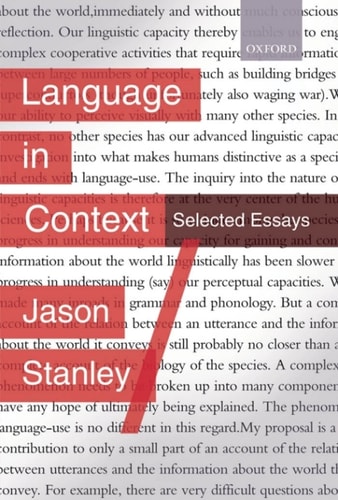
Language in Context: Selected Essays
0
0
As an Amazon Associate and affiliate partner, Menrva Books earns from qualifying purchases. Learn more
Author Description
Natural languages all contain constructions the interpretation of which depends upon the situation in which they are used. In Language and Context, Jason Stanley presents a series of essays which develop a theory of how the situation in which we speak interacts with the words we use to help produce what we say. The reason we can so smoothly operate with sentences that can be used to express very different items of information, Stanley argues, is that there are linguistically mandated constraints on the effects of the situation on what we say. These linguistically mandated constraints are most evident in the cases of sentences containing explicit pronouns, such as 'She is a mathematician', where interpretation of the information expressed is guided by the use of the pronoun 'she'. But even when such explicit pronouns are lacking, our sentences provide similar cues to allow our interlocutors to determine the information expressed. We are, in the main, confident that our interlocutors will smoothly grasp what we say, because the grammar and meaning of our sentences encodes these constraints. In defending this theory, Stanley pays close attention to specific cases of context-sensitive constructions, such as quantified noun phrases, comparative adjectives, and conditionals. Philosophers and cognitive scientist have appealed to the dependence of what is intuitively said by a sentence on the situation in which it is uttered to argue against the possibility of a systematic theory of meaning for natural language. The theory developed in this book is a vigorous defence of the possibility of a systematic theory of meaning for natural language against these influential tendencies.
Menrva's Summary
THE THESIS
This collection of essays investigates how the situational context of an utterance interacts with linguistic structure to determine the specific information conveyed by a sentence. Jason Stanley, a professor of philosophy, utilizes formal semantic analysis and linguistic theory to argue that natural language contains inherent, systematic constraints that guide interpretation. By examining specific grammatical constructions, he defends the possibility of a rigorous, systematic theory of meaning against arguments that suggest context-dependence renders such a theory impossible.
THE SCOPE MAP
What You Will Find
- Analysis of context-sensitive constructions including quantified noun phrases, comparative adjectives, and conditionals.
- A theoretical framework for understanding how grammar encodes situational cues.
- Arguments addressing the intersection of philosophy of language and cognitive science.
Scope Limits
- The text focuses primarily on formal semantic theory rather than sociolinguistic or pragmatic variations in casual conversation.
- It does not provide a comprehensive overview of all linguistic subfields, concentrating instead on the specific problem of context-dependence.
THE AUTHORITY PERSPECTIVE
Scholars in the field of philosophy of language recognize this work as a significant contribution to the debate regarding semantic compositionality and context. Readers frequently note the academic density of the prose, which is intended for an audience familiar with formal logic and linguistic theory.
Page Count:
256
Publication Date:
2007-01-01
Publisher:
Clarendon Press
ISBN-10:
0191527556
ISBN-13:
9780191527555
Philosophy
Linguistics
Semantics
Mind & Body
Philosophy of
Community Tags
Similar Books