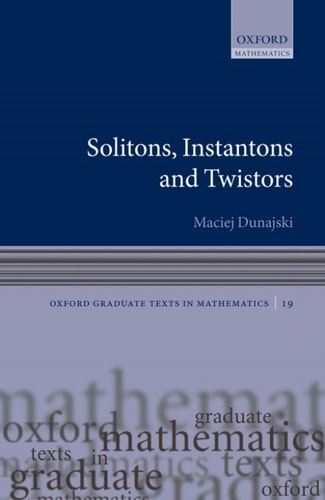
Solitons, Instantons, and Twistors
0
0
As an Amazon Associate and affiliate partner, Menrva Books earns from qualifying purchases. Learn more
Author Description
Most nonlinear differential equations arising in natural sciences admit chaotic behaviour and cannot be solved analytically. Integrable systems lie on the other extreme. They possess regular, stable, and well behaved solutions known as solitons and instantons. These solutions play important roles in pure and applied mathematics as well as in theoretical physics where they describe configurations topologically different from vacuum. While integrable equations in lower space-time dimensions can be solved using the inverse scattering transform, the higher-dimensional examples of anti-self-dual Yang-Mills and Einstein equations require twistor theory. Both techniques rely on an ability to represent nonlinear equations as compatibility conditions for overdetermined systems of linear differential equations. The book provides a self-contained and accessible introduction to the subject. It starts with an introduction to integrability of ordinary and partial differential equations. Subsequent chapters explore symmetry analysis, gauge theory, gravitational instantons, twistor transforms, and anti-self-duality equations. The three appendices cover basic differential geometry, complex manifold theory, and the exterior differential system.
Menrva's Summary
THE THESIS
This text investigates the mathematical framework of integrable systems, specifically focusing on how solitons, instantons, and twistor theory allow for the analytical solution of nonlinear differential equations. Maciej Dunajski, a researcher in mathematical physics, synthesizes complex concepts from differential geometry and gauge theory to provide a structured approach to these systems. The book argues that by representing nonlinear equations as compatibility conditions for linear systems, one can derive stable solutions that are otherwise inaccessible through standard chaotic modeling.
THE SCOPE MAP
What You Will Find
- Symmetry analysis and gauge theory applications
- Gravitational instantons and anti-self-duality equations
- Twistor transforms and their role in higher-dimensional equations
- Appendices on differential geometry and complex manifold theory
Scope Limits
- The text assumes a foundational knowledge of graduate-level mathematics and physics
- It does not cover numerical methods for non-integrable systems
THE AUTHORITY PERSPECTIVE
Experts identify this work as a rigorous and accessible entry point for graduate students entering the field of integrable systems. Readers frequently note the clarity of the mathematical derivations and the utility of the included appendices for bridging gaps in prerequisite knowledge.
Page Count:
359
Publication Date:
2009-01-01
Publisher:
OUP Oxford
ISBN-10:
0191574104
ISBN-13:
9780191574108
Mathematics
Geometry
Mathematics - General
Mathematics Statistics
Mathematical Physics
Theoretical Physics
Community Tags
Other Editions(6)




Similar Books










Reader Comments
Share Your Thoughts
No comments yet. Be the first to share your thoughts!