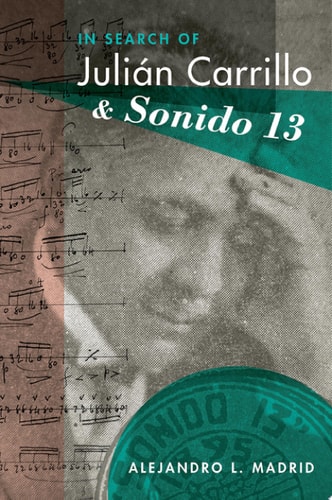
In Search of Julián Carrillo and Sonido 13
0
0
As an Amazon Associate and affiliate partner, Menrva Books earns from qualifying purchases. Learn more
Author Description
In the 1920s, the Mexican composer Julián Carrillo (1875-1965) developed a microtonal system called El Sonido 13 (The 13th Sound). Although his pioneering role as one of the first proponents of microtonality within the Western art music tradition elevated Carrillo to iconic status among European avant-garde circles in the 1960s and 1970s, his music and legacy have remained largely overlooked by music scholars, critics, and performers.Confronting this paucity of scholarship on Carrillo and his music, Alejandro L. Madrid goes above and beyond "filling in" the historical record. Combining archival and ethnographic research with musical analysis and cultural theory, Madrid argues that Carrillo and Sonido 13 are best understood as a cultural complex: a network of moments, spaces, and articulations in which Carrillo and his music continuously re-acquire significance and meaning. Thus, Madrid explores Carrillo's music and ideas not only in relation to the historical moments of their inception, but also in relation to the various cultural projects that kept them alive and re-signified them through the beginning of the twenty-first century. Eschewing traditionally linear historical frameworks, In Search of Julián Carrillo and Sonido 13 employs an innovative transhistorical narrative in which past, present, and future are explored dialogically in order to understand the politics of performance and self-representation behind Carrillo and Sonido 13.In Search of Julián Carrillo and Sonido 13 transforms the traditional genre of the composer study, treating it not as a celebration of "masters" and "masterworks," but as a pointed postcolonial intervention that offers invaluable insight into the politics of cultural exchange, experimentalism, marginality, and cultural capital in twentieth century Mexico.
Menrva's Summary
THE THESIS
How can the legacy of Mexican composer Julián Carrillo and his microtonal system, Sonido 13, be re-evaluated through a postcolonial lens that accounts for both historical context and ongoing cultural re-signification? Alejandro L. Madrid, a scholar of Latin American music and culture, utilizes a combination of archival research, ethnographic fieldwork, and musicological analysis to challenge traditional composer-study frameworks. He posits that Carrillo’s work functions as a complex cultural network rather than a static historical artifact, arguing that the composer's significance is continuously negotiated through shifting political and artistic projects.
THE SCOPE MAP
What You Will Find
- Analysis of the Sonido 13 microtonal system and its reception in European avant-garde circles.
- A transhistorical methodology that links early twentieth-century Mexican experimentalism to twenty-first-century cultural politics.
- Examination of the intersection between musical innovation, marginality, and the acquisition of cultural capital.
Scope Limits
- The text does not provide a comprehensive, chronological biography of Carrillo’s personal life.
- It does not offer a technical manual for performing microtonal music.
THE AUTHORITY PERSPECTIVE
Scholars and musicologists frequently cite this work as a significant departure from traditional hagiographic composer studies, praising its innovative use of cultural theory. Readers often note the academic density of the prose, which is intended for those familiar with postcolonial discourse and musicological analysis.
Page Count:
328
Publication Date:
2015-09-02
Publisher:
Oxford University Press
ISBN-10:
019021578X
ISBN-13:
9780190215781
Biography
Musicology
American History
Music History
Criticism history
Music mexican
Cultural Theory
Community Tags
Other Editions(4)


Similar Books











Reader Comments
Share Your Thoughts
No comments yet. Be the first to share your thoughts!