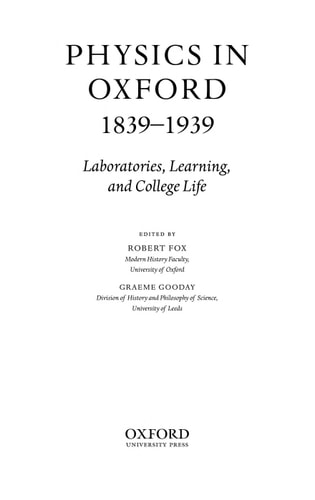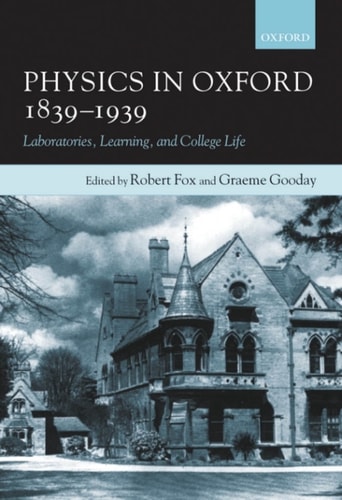
Physics in Oxford, 1839-1939: Laboratories, Learning, and College Life
0
0
As an Amazon Associate and affiliate partner, Menrva Books earns from qualifying purchases. Learn more
Author Description
Physics in Oxford, 1839-1939 offers a challenging new interpretation of pre-war physics at the University of Oxford, which was far more dynamic than most historians and physicists have been prepared to believe. It explains, on the one hand, how attempts to develop the University's Clarendon Laboratory by Robert Clifton, Professor of Experimental Philosophy from 1865 to 1915, were thwarted by academic politics and funding problems, and latterly by Clifton's idiosyncratic concern with precision instrumentation. Conversely, by examining in detail the work of college fellows and their laboratories, the book reconstructs the decentralized environment that allowed physics to enter on a period of conspicuous vigour in the late nineteenth and early twentieth centuries, especially at the characteristically Oxonian intersections between physics, physical chemistry, mechanics, and mathematics. Whereas histories of Cambridge physics have tended to focus on the self-sustaining culture of the Cavendish Laboratory, it was Oxford's college-trained physicists who enabled the discipline to flourish in due course in university as well as college facilities, notably under the newly appointed professors, J. S. E. Townsend from 1900 and F. A. Lindemann from 1919. This broader perspective allows us to understand better the vitality with which physicists in Oxford responded to the demands of wartime research on radar and techniques relevant to atomic weapons and laid the foundations for the dramatic post-war expansion in teaching and research that has endowed Oxford with one of the largest and most dynamic schools of physics in the world.
Menrva's Summary
THE THESIS
This book investigates the evolution of physics research and education at the University of Oxford between 1839 and 1939, challenging the perception that the institution was stagnant during this period. The authors, Graeme Gooday and Robert Fox, utilize archival records and institutional history to argue that a decentralized, college-based model fostered significant scientific growth despite the limitations faced by the central Clarendon Laboratory. Their analysis highlights how the interplay between college fellows and university professors created a unique environment that eventually supported major advancements in physics, physical chemistry, and mathematics.
THE SCOPE MAP
What You Will Find
- Historical analysis of the Clarendon Laboratory under Robert Clifton.
- Examination of the decentralized college-based research model.
- Documentation of the influence of J. S. E. Townsend and F. A. Lindemann.
- Analysis of the intersection between physics, mechanics, and physical chemistry.
- Contextualization of pre-war research in relation to later wartime radar and atomic developments.
Scope Limits
- The study focuses primarily on the period ending in 1939 and does not provide an exhaustive account of post-war physics developments.
- The text does not offer a comparative analysis of physics programs outside of the United Kingdom.
THE AUTHORITY PERSPECTIVE
Historians of science recognize this work as a significant corrective to the Cambridge-centric narrative of British physics history. Readers frequently note the academic density of the prose, which provides a rigorous and detailed account of institutional development for scholars and specialists.
Page Count:
386
Publication Date:
2005-01-01
Publisher:
Oxford University Press
ISBN-10:
019152445X
ISBN-13:
9780191524455
Earth Sciences
Academic History
Physics
Oxford University
Science History