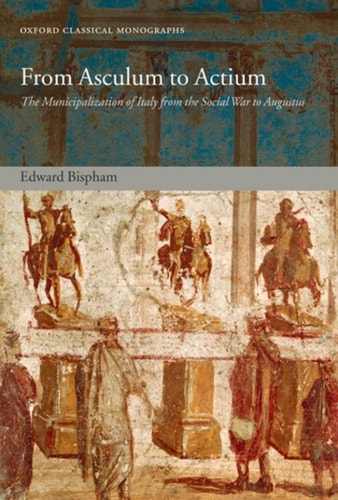
From Asculum to Actium: The Municipalization of Italy from the Social War to Augustus
0
0
As an Amazon Associate and affiliate partner, Menrva Books earns from qualifying purchases. Learn more
Author Description
Rome's once independent Italian allies became communities of a new Roman territorial state after the Social War of 91-87 BC. Edward Bispham examines how the transition from independence to subordination was managed, and how, between the opposing tensions of local particularism, competing traditions and identities, aspirations for integration, cultural change, and indifference from Roman central authorities, something new and dynamic appeared in the jaded world of the late Republic. Bispham charts the successes and failures of the attempts to make a new political community (Roman Italy), and new Roman citizens scattered across the peninsula - a dramatic and important story in that, while Italy was being built, Rome was falling apart; and while the Roman Republic fell, the Italian municipal system endured, and made possible the government, and even the survival, of the Roman empire in the West.
Menrva's Summary
THE THESIS
How did the transition from independent Italian allied communities to a unified Roman territorial state reshape the political and social landscape of the late Republic? Edward Bispham, a scholar of Roman history, utilizes archaeological evidence, epigraphic data, and literary sources to analyze the integration of Italy into the Roman state. He argues that the municipalization process was a complex negotiation between local identities and central Roman authority, ultimately creating a durable system that outlasted the Republic itself.
THE SCOPE MAP
What You Will Find
- Analysis of the Social War and its immediate political aftermath.
- Examination of the tension between local particularism and Roman integration.
- Study of the development of the municipal system as a mechanism for imperial governance.
- Synthesis of epigraphic and archaeological evidence regarding Italian urban centers.
Scope Limits
- The text focuses primarily on the period from the Social War to the Augustan age.
- It does not provide a comprehensive military history of the Roman expansion beyond the context of municipal integration.
THE AUTHORITY PERSPECTIVE
Scholars recognize this work as a rigorous and detailed examination of the administrative transformation of Italy during the late Republic. Readers frequently note the academic density of the prose, which is intended for specialists in classical history and Roman political structures.
Page Count:
600
Publication Date:
2007-01-01
Publisher:
OUP Oxford
ISBN-10:
0191528293
ISBN-13:
9780191528293
History
Sociology
Ancient History
Ancient - Rome
Italy history
Political History
Community Tags
Other Editions(2)

Similar Books