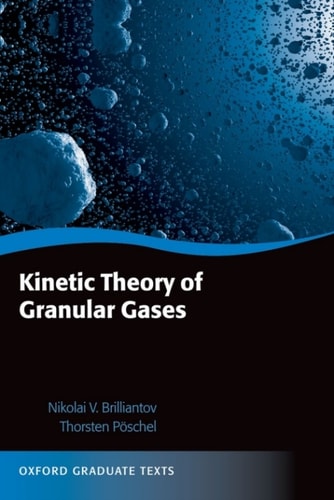
Kinetic Theory of Granular Gases
0
0
As an Amazon Associate and affiliate partner, Menrva Books earns from qualifying purchases. Learn more
Author Description
Kinetic Theory of Granular Gases provides an introduction to the rapidly developing theory of dissipative gas dynamics - a theory which has mainly evolved over the last decade. The book is aimed at readers from the advanced undergraduate level upwards and leads on to the present state of research. Throughout, special emphasis is put on a microscopically consistent description of pairwise particle collisions which leads to an impact-velocity-dependent coefficient of restitution. The description of the many-particle system, based on the Boltzmann equation, starts with the derivation of the velocity distribution function, followed by the investigation of self-diffusion and Brownian motion. Using hydrodynamical methods, transport processes and self-organized structure formation are studied. An appendix gives a brief introduction to event-driven molecular dynamics. A second appendix describes a novel mathematical technique for derivation of kinetic properties, which allows for the application of computer algebra. The text is self-contained, requiring no mathematical or physical knowledge beyond that of standard physics undergraduate level. The material is adequate for a one-semester course and contains chapter summaries as well as exercises with detailed solutions. The molecular dynamics and computer-algebra programs can be downloaded from a companion web page.
Menrva's Summary
THE THESIS
This text investigates the theoretical framework of dissipative gas dynamics, specifically focusing on the kinetic behavior of granular gases. Authors Nikolai V. Brilliantov and Thorsten Pöschel provide a systematic derivation of macroscopic properties from microscopic collision models, establishing a foundation for understanding non-equilibrium systems where energy is not conserved during particle interactions.
THE SCOPE MAP
What You Will Find
- Derivation of velocity distribution functions using the Boltzmann equation
- Analysis of self-diffusion and Brownian motion in granular systems
- Application of hydrodynamical methods to transport processes and structure formation
- Appendices covering event-driven molecular dynamics and computer algebra techniques
Scope Limits
- The text assumes a standard undergraduate physics background and does not provide introductory material for basic mechanics
- The focus remains strictly on granular gases rather than broader condensed matter physics
THE AUTHORITY PERSPECTIVE
Experts recognize this work as a foundational resource for researchers and advanced students entering the field of granular gas dynamics. Readers frequently note the clarity of the mathematical derivations and the utility of the included exercises for classroom instruction.
Page Count:
142
Publication Date:
2004-01-01
Publisher:
OUP Oxford
ISBN-10:
0191523917
ISBN-13:
9780191523915
Statistical mechanics
Physics
Academic Textbooks
Earth Sciences
Fluid dynamics