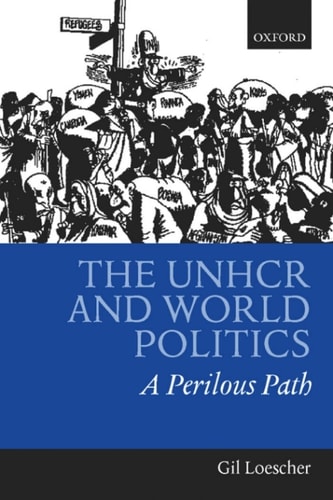
The UNHCR and World Politics: A Perilous Path
0
0
As an Amazon Associate and affiliate partner, Menrva Books earns from qualifying purchases. Learn more
Author Description
Over fifty years ago governments established the Office of the United Nations High Commissioner for Refugees (UNHCR) to protect the world's refugees. The UNHCR was created to be a human rights and advocacy organization. But governments also created the agency to promote regional and international stability and to serve the interests of states. Consequently, the UNHCR has always trod a perilous path between its mandate to protect refugees and asylum seekers and the demands placed upon it by states to be a relevant actor in world politics. This is the first independent history of the UNHCR. Gil Loescher, one of the world's leading experts on refugee affairs, draws upon decades of personal experience and research to examine the origins and evolution of the UNHCR as well as to identify many of the major challenges facing the organization in the years ahead. A key focus is to examine the extent to which the evolution of the UNHCR has been framed by the crucial events of international politics during the past half century and how, in turn, the actions of the eight past High Commissioners have helped shape the course of world history. Each chapter tells the story of an individual High Commissioner and examines the unique contributions made to the development of the Office. The history of the last fifty years shows how the UNHCR has initiated and capitalized on international political developments to progressively expand its scope and authority as an important actor in world politics. The book argues that the UNHCR has overstretched itself in recent decades and has strayed from its central human rights protection role. The protection of refugees remains a litmus test of the international community's commitment to defend human rights and to uphold liberal democratic values. Loescher offers a series of bold policy recommendations aimed at making the agency a more effective and accountable advocate for the millions of refugees in the world today.
Menrva's Summary
THE THESIS
This book investigates the fundamental tension between the UNHCR's humanitarian mandate to protect refugees and the political pressures exerted by sovereign states to maintain international stability. Gil Loescher, a recognized authority on refugee affairs, utilizes extensive archival research and decades of personal observation to trace the agency's evolution. He argues that the organization has increasingly overextended its reach, often at the expense of its core human rights mission, and proposes policy reforms to restore its effectiveness.
THE SCOPE MAP
What You Will Find
- A comprehensive historical analysis of the UNHCR from its inception to the early 2000s.
- Individual assessments of the tenures of the eight High Commissioners who led the agency.
- An examination of how international political events have dictated the agency's expansion and operational scope.
- Policy recommendations for improving agency accountability and advocacy.
Scope Limits
- The text focuses primarily on the institutional and political history of the organization rather than individual refugee narratives.
- The analysis concludes in the early 2000s and does not cover subsequent shifts in global migration policy.
THE AUTHORITY PERSPECTIVE
Experts and scholars in international relations identify this work as a foundational text for understanding the intersection of humanitarianism and state interests. Readers frequently note the academic density of the prose, which provides a rigorous, evidence-based account of the agency's institutional development.
Page Count:
448
Publication Date:
2001-01-01
Publisher:
Oxford University Press
ISBN-10:
019152994X
ISBN-13:
9780191529948
History
International relations
Human rights
United Nations
Community Tags
Other Editions(2)
Similar Books
Reader Comments
Share Your Thoughts
No comments yet. Be the first to share your thoughts!