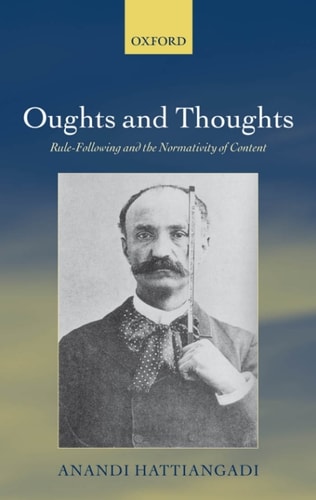
Oughts and Thoughts: Rule-Following and the Normativity of Content
0
0
As an Amazon Associate and affiliate partner, Menrva Books earns from qualifying purchases. Learn more
Author Description
In Oughts and Thoughts, Anandi Hattiangadi provides an innovative response to the argument for meaning scepticism set out by Saul Kripke in Wittgenstein on Rules and Private Language. Kripke asks what makes it the case that anybody ever means anything by any word, and argues that there are no facts of the matter as to what anybody ever means. Kripke's argument has inspired a lively and extended debate in the philosophy of language, as it raises some of the most fundamental issues in the field: namely, the reality, privacy, and normativity of meaning. Hattiangadi argues that in order to achieve the radical conclusion that there are no facts as to what a person means by a word, the sceptic must rely on the thesis that meaning is normative, and that this thesis fails. Since any 'sceptical solution' to the sceptical problem is irremediably incoherent, Hattiangadi concludes that there must be a fact of the matter about what we mean. In addition to providing an overview of the debate on meaning and content scepticism, Hattiangandi presents a detailed discussion of the contributions made by Simon Blackburn, Paul Boghossian, Robert Brandom, Fred Dretske, John McDowell, and Crispin Wright, among others, to the controversy surrounding Kripke's argument. The issues considered include the normativity of meaning and its relation to the normativity of moral judgments, reductive and non-reductive theories of meaning, deflationism about truth and meaning, and the privacy of meaning.
Menrva's Summary
THE THESIS
This book investigates the core question of whether meaning is inherently normative and if the absence of such normativity necessitates a skeptical conclusion regarding the existence of semantic facts. Anandi Hattiangadi, a philosopher specializing in the philosophy of language and mind, evaluates the skeptical challenge posed by Saul Kripke regarding rule-following. She argues that the skeptic's position relies on a flawed premise concerning the normativity of meaning, ultimately asserting that there are indeed objective facts about what individuals mean by their words.
THE SCOPE MAP
What You Will Find
- A critical analysis of Saul Kripke's interpretation of Wittgenstein on rules and private language
- A comparative evaluation of theories from philosophers including Simon Blackburn, Paul Boghossian, Robert Brandom, Fred Dretske, John McDowell, and Crispin Wright
- Discussions on the relationship between semantic normativity and moral judgment
- Examinations of reductive versus non-reductive theories of meaning and deflationism
Scope Limits
- The text does not provide an introductory survey for readers unfamiliar with analytic philosophy
- It does not address empirical linguistic data or psychological studies on language acquisition
THE AUTHORITY PERSPECTIVE
Scholars and students of analytic philosophy frequently cite this work as a rigorous intervention in the post-Kripkean debate on rule-following. Readers often note the high level of academic density and the technical precision required to engage with the author's arguments.
Page Count:
210
Publication Date:
2007-01-01
Publisher:
Clarendon Press
ISBN-10:
0191527408
ISBN-13:
9780191527401
Philosophy
Logic
Skepticism
Metaphysics
Epistemology
Philosophy of
Community Tags
Similar Books