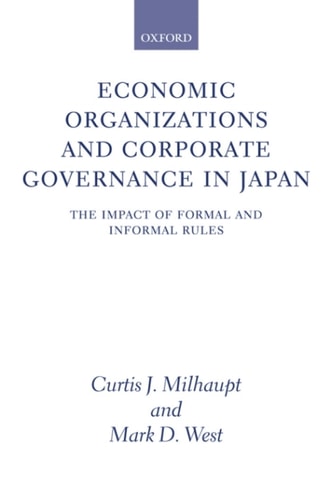
Economic Organizations and Corporate Governance in Japan: The Impact of Formal and Informal Rules
0
0
As an Amazon Associate and affiliate partner, Menrva Books earns from qualifying purchases. Learn more
Author Description
Using an institutional and empirical approach, this book analyses the role of formal rules (law and regulations) and informal rules (norms, practices, and shared beliefs) in the Japanese economy. Through in-depth studies of corporate governance and finance, mergers and acquisitions, financial regulation, and markets for everything from venture capital to legal talent and organized crime, Milhaupt and West show that institutions play a crucial and heretofore overlooked role in the structure of the Japanese economy, which often is portrayed as being governed exclusively by interpersonal relations and bureaucratic fiat. The book demonstrates that despite outward appearances of a decade of stagnation in Japan, the formal and informal rules of the Japanese economy are changing significantly. The evidence suggests that in the mix of formal and informal rules that govern Japanese firms and set the incentive structure for other economic actors, law is gaining in importance. As these rules change, Japanese actors are responding, reshaping corporate governance and financial markets, eroding the bureaucracy's power. This book's emphasis on the centrality of institutions, institutional change, and responses to change portray a Japanese economy far different from those provided by previous accounts. It provides a wealth of previously unexplored data on the Japanese economy and legal system, and demonstrates the importance of a sound incentive roadmap for Japan's economic recovery and transition.
Menrva's Summary
THE THESIS
This book investigates how the interplay between formal legal regulations and informal social norms dictates the structure and evolution of the Japanese economy. Authors Curtis J. Milhaupt and Mark D. West utilize an institutional and empirical framework to challenge the conventional view that Japan's economy is governed solely by bureaucratic fiat or interpersonal relationships. By analyzing specific sectors, they argue that formal law is increasingly influencing economic behavior and reshaping corporate governance, signaling a significant shift in the nation's institutional landscape.
THE SCOPE MAP
What You Will Find
- Empirical analysis of corporate governance, finance, and mergers and acquisitions in Japan.
- Examination of diverse markets including venture capital, legal talent, and organized crime.
- A framework for understanding institutional change and incentive structures.
Scope Limits
- The analysis focuses primarily on the Japanese market and may not be directly applicable to other economic systems.
- The text does not provide a comprehensive history of Japanese economic policy prior to the modern era.
THE AUTHORITY PERSPECTIVE
Experts recognize this work as a significant contribution to the study of comparative law and institutional economics. Readers frequently note the academic density of the prose and the depth of the empirical data provided by the authors.
Page Count:
262
Publication Date:
2004-01-01
Publisher:
Oxford University Press
ISBN-10:
0191534056
ISBN-13:
9780191534058
Economics
Law
Social Science
Corporate governance
Finance
Japan
Community Tags
Similar Books